
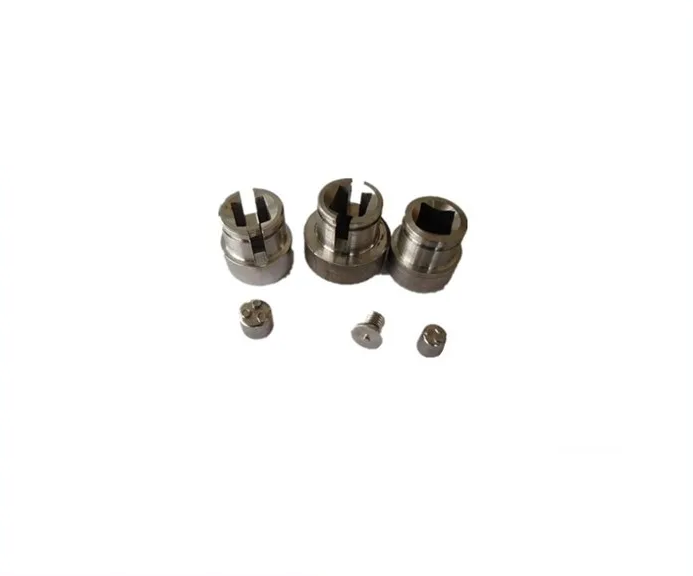
What a lock drive shaft transfers between input and mechanism
Review this component together with its mating parts and delivered condition. The interfaces below define the drawing information needed to assess forming, finishing and inspection.
A material code must be confirmed rather than treated as a universal specification.
Drive section, retaining feature and mating-bore interfaces
Define the drive section, retaining features and mating bore.
Identify whether the requested item is the shaft, coupling or another member shown in the reference.
Why specify the shaft and coupling separately when needed?
A catalog group may show both drive members without defining their assembly.
Separating their drawings clarifies which fit belongs to each part and what is supplied.
A combined quotation can then include an explicit mating and inspection arrangement.
Turning, machining and MIM for round and non-round features
Compare turning, machining and MIM for the specific combination of round and non-round features.
Confirm material and heat-treatment requirements before finalizing the route.
The proposed route is confirmed for your drawing, material and quantity. An image does not establish a fixed tolerance or a complete process specification.
Compare manufacturing capabilities →Lock drive shaft material, treated-surface and corrosion requirements
Specify the base material, final condition and corrosion or appearance requirements.
Mark drive, guiding and contact surfaces that must meet their dimensions after treatment.
The component specification does not establish a security rating for the complete lock.
Review material-selection information →Drive fit, retention and material-record checks
Check drive fit, angular orientation, retention and final material records.
Evaluate the mechanism in the treated and finished condition.
Specify the drawing revision and the condition in which each dimension is inspected. Record the agreed dimensional and functional checks before sample approval.
Quality documentation →Prepare a Product-Specific RFQ
- Component definition. Send the 2D drawing and 3D model, where available, with the drawing revision and the requested part or assembly scope.
- Mating information. Include the assembly references needed to define the interfaces discussed above.
- Delivered condition. State material, finishing and inspection requirements, identifying any items that need a manufacturing recommendation.
- Supply plan. Include sample needs, expected order and annual quantities, packaging requirements and target timing.
Product Questions
Can the material code be used without a specification?
No. Confirm the material standard, grade and final condition required for the new project.
Why specify the shaft and coupling separately when needed?
A catalog group may show both drive members without defining their assembly. Separating their drawings clarifies which fit belongs to each part and what is supplied. A combined quotation can then include an explicit mating and inspection arrangement.
How should the completed mechanism be checked?
Check drive fit, angular orientation, retention and final material records. Evaluate the mechanism in the treated and finished condition.
Technical Context
The product-specific notes above identify drawing-review questions. General process and material references are collected separately; they do not verify a material grade, production qualification or performance claim for the pictured part.
Manufacturing and material references →