
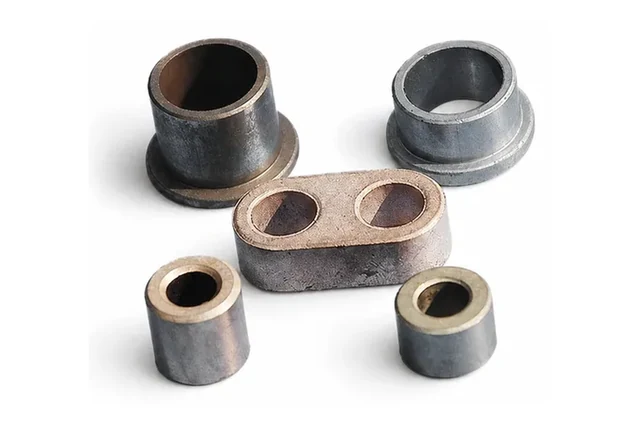
Plain and flanged bushing references
Define the mating shaft, housing fit and running clearance for the assembly.
Read engineering guide →Custom bushings and press-and-sinter structural parts for bearing, locating and load-carrying interfaces.
Define the mating shaft, housing fit and running clearance for the assembly.
Read engineering guide →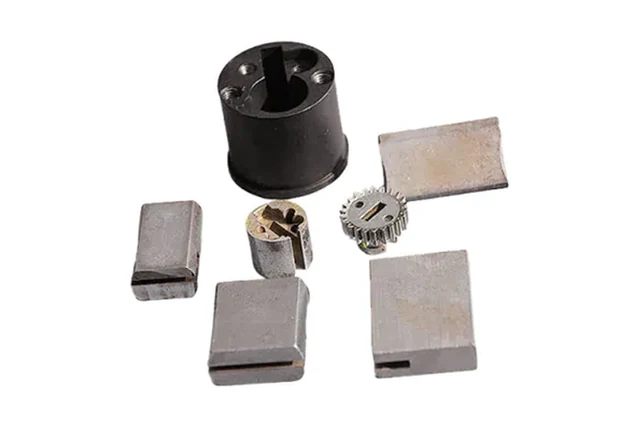
Compaction direction, wall transitions and local loading guide the manufacturing review.
Discuss a similar component →Representative custom component references. Dimensions, material, manufacturing route and validation requirements are confirmed from your drawing; these are not off-the-shelf catalog items.
Cylindrical bearing interfaces where bore size, wall section, load, lubrication and wear drive the specification.
PM parts can be sized after sintering when dimensional repeatability on a bore or outside diameter is important, subject to part geometry and specification.
Hubs, blocks, carriers and compact functional shapes that can be pressed along a practical compaction direction.
Near-net-shape PM blanks can keep the bulk geometry economical while machining only threads, cross-holes, sealing faces or precision datums.
| Review area | Information to define | Manufacturing decision |
|---|---|---|
| Bearing interface | Housing fit, shaft tolerance, running clearance, bearing length and installation method. | Assess whether sizing, bore finishing or final assembly checks are required. |
| Load & motion | Radial/axial load, speed, oscillating motion, duty cycle and allowable wear. | Review contact pressure and material condition in the actual operating context. |
| Lubrication | Lubricant, temperature, contamination and maintenance expectations. | Oil impregnation is specified and validated when needed; not every PM bushing is self-lubricating. |
| Structural geometry | Pressing direction, wall sections, flanges, transverse holes and density targets. | Identify features that need secondary machining and define critical inspection locations. |
Material & final condition. Iron- or copper-based powder systems are reviewed against bearing duty, density, lubrication and corrosion requirements. Structural PM parts require their own load and material review rather than inheriting a bushing specification. Review material data →
| Part condition | PM fit | What to review |
|---|---|---|
| Simple bushing / sleeve | Often a strong PM screening candidate at repeat volume. | Bore/OD, wall thickness, flange features, load, wear, lubrication and any sizing requirement. |
| Press-friendly structural part | Strong when major features align with compaction direction. | Tool access, density distribution, ejection, unsupported thin sections and transverse features. |
| Cross-holes / undercuts / complex 3D features | May need machining, special tooling, MIM or another route. | Do not force conventional PM if secondary operations or tooling complexity remove the economic benefit. |
| High precision on selected surfaces | PM blank + sizing/machining/grinding may be appropriate. | Identify only the interfaces that truly require tighter control. |
| Low-volume prototype | Direct machining may be more practical. | Tooling economics and qualification cost should be weighed against projected program life. |
Required density and mechanical performance depend on material, geometry, compaction, sintering and load. SINTS reviews these requirements against your drawing and application.
Review geometry, material and volume, identify critical features and clarify the proposed tooling and secondary operations.
Define trial parts, dimensional checks, material confirmation and any customer-required functional approval.
Confirm the approved route, control plan, packaging and repeat-supply requirements for the program.
Drive and pivot support interfaces exposed to dust, moisture and repeated duty.
Application guide →Pivot and gearbox support bushings where wear and clearance affect mechanism feel.
Application guide →Bearing or locating-adjacent components where fit and cycle life matter.
Application guide →Bushings and drive-support parts where wear, filler abrasion and chemical exposure may matter.
Application guide →The retained bushing detail page focuses on bore/OD, load, lubrication, wear, sizing and secondary-machining decisions for sleeve and flanged forms.
Send mating shaft/housing dimensions, load, motion, lubrication, environment, density or material targets and annual quantity.