
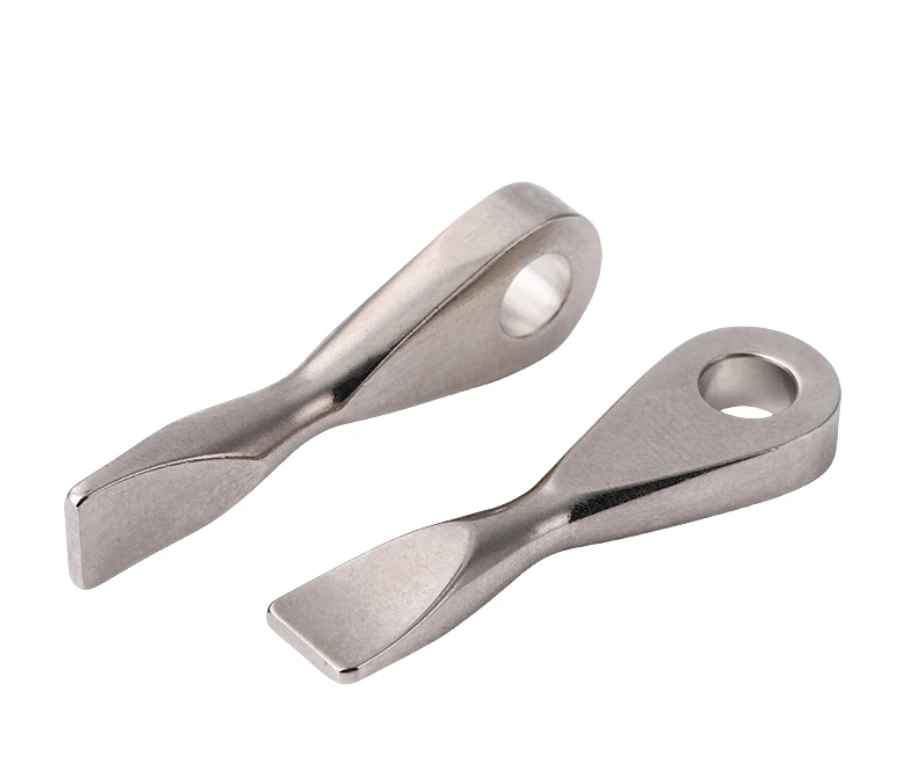
What structural links transfer between connected members
Review this component together with its mating parts and delivered condition. The interfaces below define the drawing information needed to assess forming, finishing and inspection.
The reference shows shaped ends and openings that should be reviewed as part of the complete load path.
Mating pins, load direction and eye-to-contact interfaces
Provide the mating pins, load directions and the relationship between the eyes and contact surfaces.
Mark any geometry that positions the link in the assembly.
Why review a link's eyes as a connected geometry?
The eyes locate the link between mating members and establish its orientation in the assembly.
Their relationship matters alongside the dimensions of each opening.
Reviewing the connected geometry helps distinguish individual hole conformity from the required assembled position.
Powder forming versus machining for section changes
Compare powder forming, machining and other suitable routes for the section changes and quantity.
Pin fits and load-bearing contacts may need final operations.
The proposed route is confirmed for your drawing, material and quantity. An image does not establish a fixed tolerance or a complete process specification.
Compare manufacturing capabilities →Structural link alloy, contact and delivered-condition requirements
Specify the actual alloy or functional material requirements rather than relying on color or a trade name.
Specialty material requests need an individual process review.
Define visible surfaces, contact requirements and final dimensions in the delivered condition.
Review material-selection information →Eye geometry, alignment and contact-fit checks
Check eye geometry, alignment, contact fit and the specified material condition.
Agree the load or cycle verification with the actual assembly requirements.
Specify the drawing revision and the condition in which each dimension is inspected. Record the agreed dimensional and functional checks before sample approval.
Quality documentation →What sets the price of a PM structural link
A pressed structural link sits between two routes: it is cheaper to tool than a MIM part and lower in density, which limits how much load it can carry. The cost question and the strength question are therefore the same question.
| Cost element | Why a small order costs more per piece | Why a large order stops getting cheaper |
|---|---|---|
| The compacting tool | A single-action press tool for a link is simpler than an injection mould, so tooling is lower. It also cannot produce undercuts, which constrains the design from the start. | Tooling is amortised early. Because it is lower, the quantity needed to justify it is also lower than for MIM. |
| Press time per part | Each part is one press cycle, and the cycle is set by fill and ejection rather than by the size of the link. | Press time is linear in parts. Higher volume means more press hours, not a cheaper stroke. |
| Second press and re-sinter, where strength demands it | A double-press double-sinter route raises density and strength, and adds two more operations to every part. | The extra operations are per part and do not compress with volume. The decision to need them is a design decision made once. |
| Machining of the eyes | Pressed eyes are close to final but often need reaming or a ground bore for a pin fit. That is a per-part cut. | Combined tooling reduces set-up, not cut time per part. Each eye is still machined on every link. |
| Load and density verification | Where a link carries a stated load, a density check per lot and occasionally a proof test are part of the price. | Density checking is fast and stays per lot. A proof test is destructive, so it is sampled, and the sample size is a cost that volume does not remove. |
Note. The split below describes cost structure, not prices. What a specific part costs depends on its geometry, material, finish and the quantity you can commit; this page explains which of those you can move and which you cannot.
On a structural link the cost is decided by the density requirement. A link that can be single-pressed is a cheap part; the same outline at double-press density is not, and no quantity changes that. The useful enquiry states the load, so the route can be chosen before the tool is cut.
Prepare a Product-Specific RFQ
- Component definition. Send the 2D drawing and 3D model, where available, with the drawing revision and the requested part or assembly scope.
- Mating information. Include the assembly references needed to define the interfaces discussed above.
- Delivered condition. State material, finishing and inspection requirements, identifying any items that need a manufacturing recommendation.
- Supply plan. Include sample needs, expected order and annual quantities, packaging requirements and target timing.
Product Questions
Can eye spacing alone define a structural link?
No. Pin fits, section geometry, orientation and loading also determine the part's functional requirements.
Why review a link's eyes as a connected geometry?
The eyes locate the link between mating members and establish its orientation in the assembly. Their relationship matters alongside the dimensions of each opening. Reviewing the connected geometry helps distinguish individual hole conformity from the required assembled position.
What should the project acceptance plan include?
Check eye geometry, alignment, contact fit and the specified material condition. Agree the load or cycle verification with the actual assembly requirements.
Technical Context
The product-specific notes above identify drawing-review questions. General process and material references are collected separately; they do not verify a material grade, production qualification or performance claim for the pictured part.
Manufacturing and material references →