
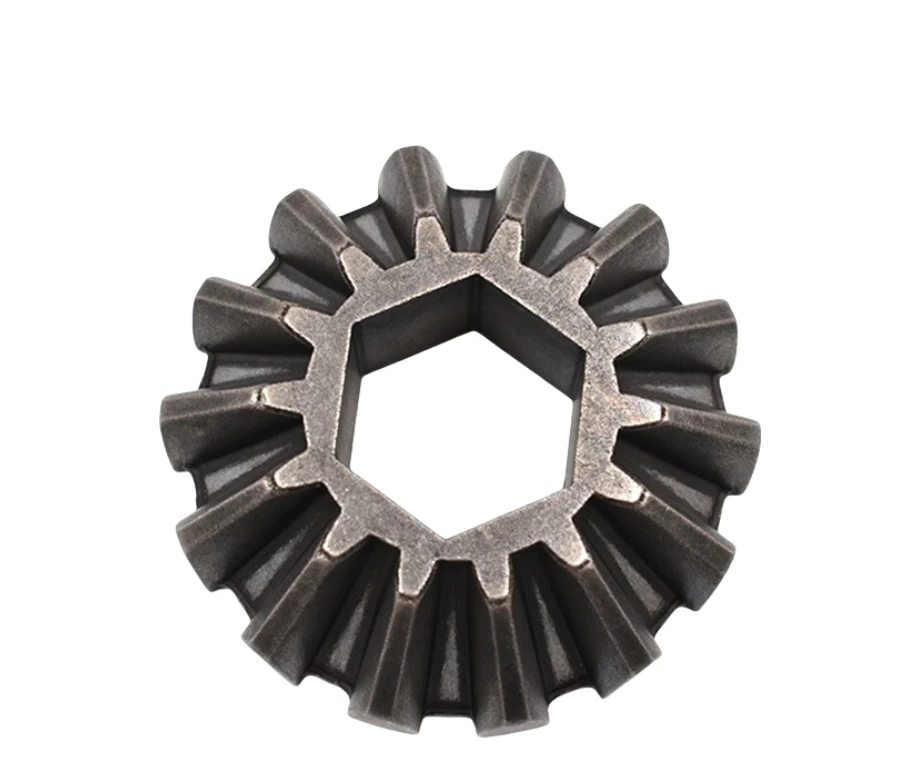
What agricultural drive parts combine in one component
Review this component together with its mating parts and delivered condition. The interfaces below define the drawing information needed to assess forming, finishing and inspection.
The reference shows why the outside tooth form and internal connection must be reviewed together.
Mating drive, tooth geometry and load-direction interfaces
Specify the mating drive, tooth geometry and working load direction.
Identify the relationship between the internal profile, tooth axis and locating faces.
Why review the internal drive and teeth together?
The internal connection brings load into the part and the external teeth transfer it onward.
Their relative geometry forms a connected system.
Reviewing only the exterior profile can miss a functional requirement at the drive or locating interface.
PM versus machining for repeated drive profiles
Compare PM and machining for a compact repeated profile, including any tooth or drive finishing.
Dirt exposure, duty and impact can change the required material and final condition.
The proposed route is confirmed for your drawing, material and quantity. An image does not establish a fixed tolerance or a complete process specification.
Compare manufacturing capabilities →Agricultural drive parts: sintering against the alternatives
For this group the first question is not cost, it is what happens when the part fails. Anything whose failure affects an operator or disables a machine belongs in a different conversation from a part that merely wears out.
| Alternative process | When it wins on this part | What puts sintering back in front |
|---|---|---|
| Forging plus machining | Wins on any drive part that sees impact. A forging carries a continuous grain flow, and that is where its impact toughness comes from. | Sintering has no grain flow to offer, and density below wrought leaves porosity as a crack path. For safety-relevant drive parts the correct answer is usually a forging, and it is worth saying so early rather than losing the comparison later. |
| Machining from bar | Wins at low volume and at large size, where no tooling is justified and the geometry is mostly turned or milled features. | Removal time scales with the volume of material taken out, so a part that is mostly a shape rather than a set of features never becomes economical to machine in quantity. |
| Sand casting plus machining | Wins on the large, low-precision housing or the heavy bracket, where mass is acceptable and the tolerance is wide. | Machining allowance has to be added to every functional face, so the casting supplies bulk and the accuracy still comes from cutting. Nothing is saved on the surfaces that matter. |
| Welded fabrication | Wins on the sprocket or the disc built up from plate, where a die would be large and the annual quantity does not justify it. | A weld introduces a heat-affected zone next to the working surface, and distortion has to be corrected afterwards. Where the teeth are the function, that correction is on the functional surface. |
| Powder metallurgy and sintering | Wins at stable medium and high volume, on parts whose teeth or internal drive are formed in the tool and whose load is steady rather than shock. Density is controlled, and the tooth form needs no machining afterwards. | It should not be offered where the load is impact or where failure is a safety event. That boundary is not negotiable, and a supplier who does not state it is not giving a useful comparison. |
Note. This table is a screening aid, not a recommendation against our own process. Where a row above describes your part better than the sintering route does, we will say so and quote against the route that actually fits; the quantities, alloy and tolerances on your drawing still decide the answer.
Ask for the basis of the material and process choice in writing, not just a certificate. On a part whose failure has consequences, traceability of the decision is worth more than a lower piece price, and it should not be left to the supplier to decide alone.
Actual alloy, contact and delivered-condition requirements
Specify the actual alloy or functional material requirements rather than relying on color or a trade name.
Specialty material requests need an individual process review.
Define visible surfaces, contact requirements and final dimensions in the delivered condition.
Review material-selection information →Internal drive, tooth profile and locating-relationship checks
Inspect the internal drive, tooth profile and locating relationships.
Approve the part against the specified operating load and mating equipment.
Specify the drawing revision and the condition in which each dimension is inspected. Record the agreed dimensional and functional checks before sample approval.
Quality documentation →Prepare a Product-Specific RFQ
- Component definition. Send the 2D drawing and 3D model, where available, with the drawing revision and the requested part or assembly scope.
- Mating information. Include the assembly references needed to define the interfaces discussed above.
- Delivered condition. State material, finishing and inspection requirements, identifying any items that need a manufacturing recommendation.
- Supply plan. Include sample needs, expected order and annual quantities, packaging requirements and target timing.
Product Questions
Can the internal drive shape be changed without reviewing the gear teeth?
The change can affect wall thickness and the load path; review the complete component rather than treating the features independently.
Why review the internal drive and teeth together?
The internal connection brings load into the part and the external teeth transfer it onward. Their relative geometry forms a connected system. Reviewing only the exterior profile can miss a functional requirement at the drive or locating interface.
What should the project acceptance plan include?
Inspect the internal drive, tooth profile and locating relationships. Approve the part against the specified operating load and mating equipment.
Technical Context
The product-specific notes above identify drawing-review questions. General process and material references are collected separately; they do not verify a material grade, production qualification or performance claim for the pictured part.
Manufacturing and material references →