
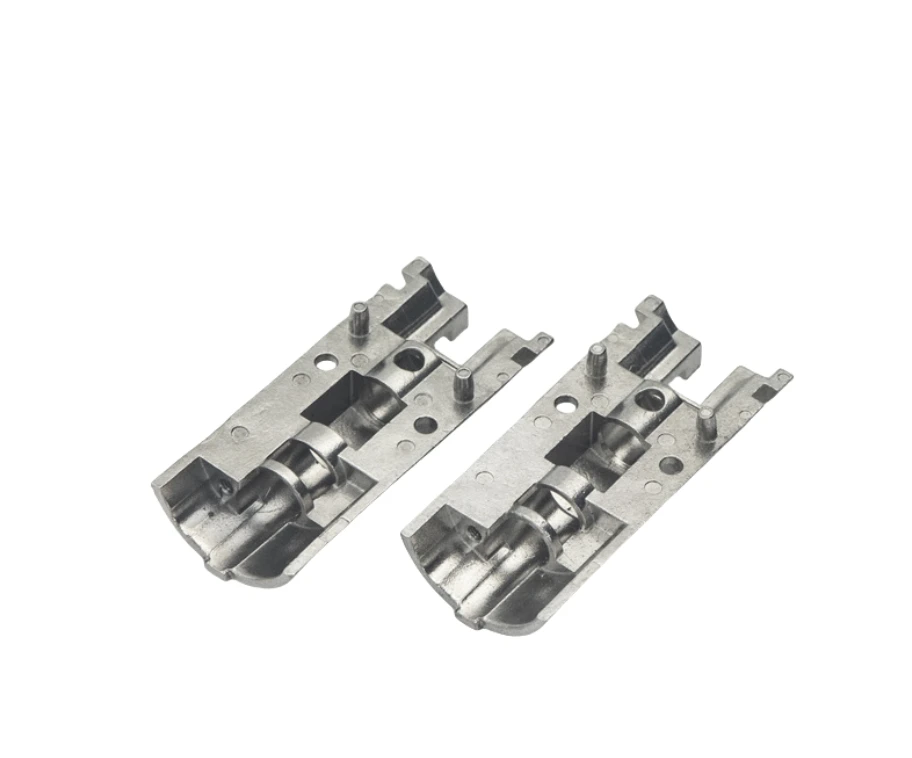
What custom lock body hardware integrates in one component
Each drawing should identify its role within the complete lock assembly.
Mounting scheme, supported members and contact-surface interfaces
Specify the mounting scheme, supported members and any working contact surfaces.
Mark features that establish position separately from clearance pockets.
Why include installation clearance for lock body hardware?
The component must permit assembly as well as operation.
A cavity or opening that fits an installed member may still need a defined installation path.
Including the neighboring parts helps identify the clearances and edges relevant to both stages.
Forming versus machining for cavities and datums
Compare forming of integrated geometry with machining where the cavity or datum requirements favor it.
Include necessary deburring and finishing access.
Compare manufacturing capabilities →Lock body hardware material, treated-surface and corrosion requirements
Specify the base material, final condition and corrosion or appearance requirements.
Mark drive, guiding and contact surfaces that must meet their dimensions after treatment.
Specify any testing required on the assembled lock separately.
Review material-selection information →Mounting, cavity and final-fit checks
Check mounting and cavity relationships, edges and final fit.
Use the intended lock assembly to confirm that neighboring parts can be installed and operated.
Quality documentation →What makes a lock body housing expensive at low volume
A lock body is a large, heavy part with cavities and mounting features. Its cost profile is the opposite of a small MIM component: material and press time matter from the first part, and tooling is spread over a much larger mass.
| Cost element | Why a small order costs more per piece | Why a large order stops getting cheaper |
|---|---|---|
| Press tonnage and projected area | The press is chosen by projected area. A large face needs a large press, and that press runs one part per stroke rather than a multi-cavity load. | Press time is proportional to strokes, so volume does not shorten it. More capacity means another press, not a cheaper part. |
| Powder consumption | A heavy part consumes material in proportion to its mass, and on this class of part material is a substantial share of the first quotation. | Material follows the metal market and the mass of the part. Design, not order size, is what reduces it. |
| Furnace load by weight and height | A lock body takes vertical space in the furnace. Fewer parts fit per load than with small components, so the cycle cost is spread over less pieces. | The load is limited by the chamber, and the chamber is already full. Extra volume buys cycles, not efficiency. |
| Machining of cavities, threads and seats | A formed cavity is close to final, but threads and seating faces are cut. Each cut face is a set-up and a per-piece time. | Multi-part fixtures and combined tools cut the time per part. They do not remove operations, and each feature still has to be cut on every part. |
| Coating or plating by surface area | Finishing is priced on exposed area. A body has a lot of it, and rack or jig space is used up quickly. | Surface treatment is close to linear with area. It is one of the few lines where the cost per part is predictable and does not improve with scale. |
For a price comparison, use the same material, finish, order quantity and inspection requirements.
On a body this size the first three lines dominate, and none of them improve much with quantity. The lever that works here is geometry: a smaller projected area, a cavity that needs no secondary cut, a seat that can be formed instead of milled. Those are drawing decisions, and they are available before the first order rather than after the tenth.
What to include in your enquiry
- Drawing and mating dimensions.Specify the mounting scheme, supported members and any working contact surfaces. Include the drawing revision.
- Mating information. Include the assembly references needed to define the interfaces discussed above.
- Delivered condition. State material, finishing and inspection requirements, identifying any items that need a manufacturing recommendation.
- Supply plan. Include sample needs, expected order and annual quantities, packaging requirements and target timing.
- First-sample inspection.Check mounting and cavity relationships, edges and final fit. Specify the mating part or inspection fixture.
Common questions
Can the same lock body hardware serve several lock designs?
Only after their mounting, clearance and operating interfaces are confirmed; an identical-looking cavity is not sufficient.
Why include installation clearance for lock body hardware?
The component must permit assembly as well as operation. A cavity or opening that fits an installed member may still need a defined installation path. Including the neighboring parts helps identify the clearances and edges relevant to both stages.
How should the completed mechanism be checked?
Check mounting and cavity relationships, edges and final fit. Use the intended lock assembly to confirm that neighboring parts can be installed and operated.