
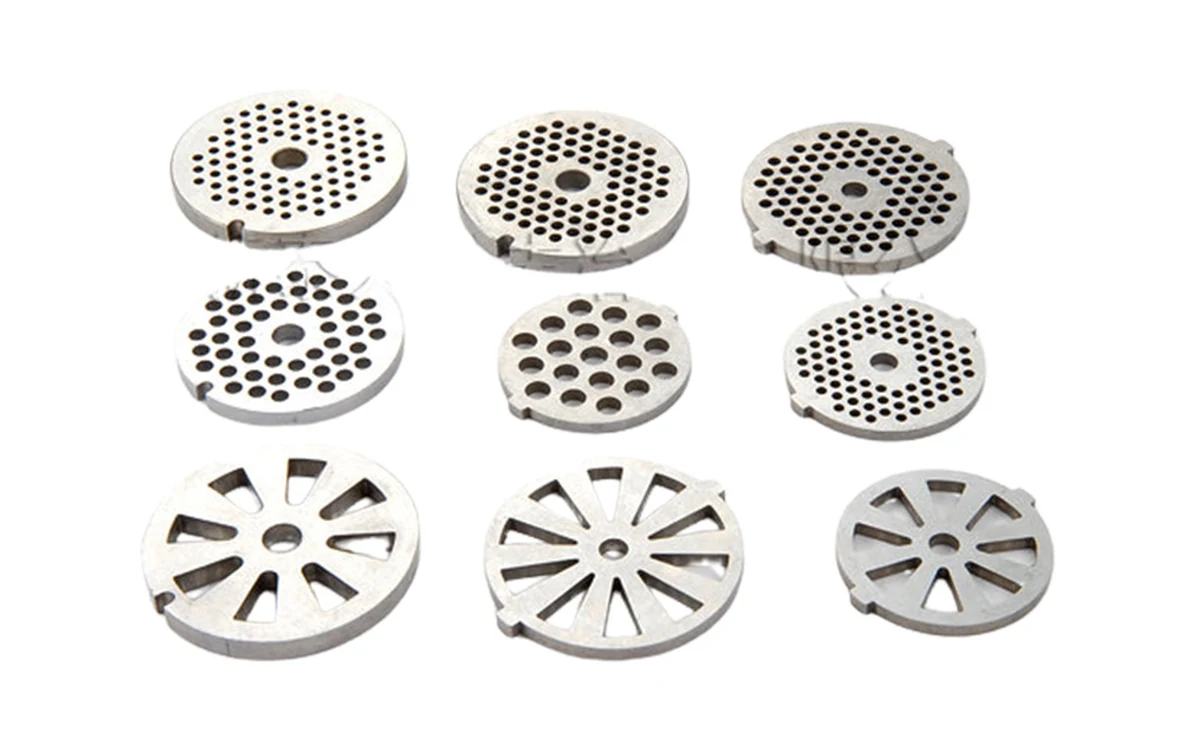
What meat grinder knives and plates do as a cutting system
The reference group includes different cutting and plate patterns, not a single universal assembly.
Knife, plate, drive shape and seating interfaces
Provide the knife and plate as a mating set, including drive shape, seating and working direction.
Hole pattern and cutting-face contact should be defined separately.
Why is knife-to-plate contact a paired requirement?
The working relationship depends on two manufactured surfaces and their mounting.
Inspecting each independently does not fully describe their contact after assembly.
A paired review makes the required relationship explicit and identifies which final surfaces need particular control.
Separating blank, opening and cutting-surface production
Review production of the blank, openings and final cutting surfaces as distinct steps.
Flatness and the working edge may require machining or grinding after forming.
Compare manufacturing capabilities →Knife and plate grade, edge and food-contact requirements
Specify the required grade or performance criteria together with cleaning, wear and appearance requirements.
For any surface that contacts food or beverage, identify the applicable customer documentation and acceptance criteria.
For contact surfaces, specify the stainless grade and finish.
Review material-selection information →Mating contact, hole pattern and drive-fit checks
Check the mating contact, hole or blade pattern, drive fit and edges.
Include cleaning and any project-specific material or contact documentation.
Quality documentation →How meat grinder knives and plates fail, and why they are judged as a pair
A grinder knife does not cut on its own. It cuts because it is pressed flat against a perforated plate, and the quality of the cut is set by the contact between the two. That makes most failures paired failures, which is why a complaint about the knife is often really a complaint about flatness.
| What goes wrong in service | What drives it | Where the drawing closes it out |
|---|---|---|
| Meat smears instead of cutting, and the mince goes warm | The knife and plate must sit flat against each other. If either face is out of flat, the knife rides on a high spot, the actual cutting edge never reaches the plate lands, and the meat is crushed rather than sheared. Heat is the tell-tale. | Flatness of both faces stated to the same requirement, with the pair identified as a matched set; verified by blue-checking the two against each other and by a cut test on an assembled head. |
| Discoloration and polish marks appear on the plate | Friction from an imperfect contact band shows up as local heating, and a stainless that has been heated and rubbed discolours before it corrodes. | Surface finish on the contact face and the clamping arrangement stated, with the plate thickness and stiffness adequate to the clamp load; verified after a run at the rated load of the motor. |
| Staining and pitting after dishwasher cycles | The food-contact grades rely on their passive layer, and that layer is weakest in a crevice. The centre square is exactly that: a tight, wet, oxygen-starved joint that stays damp after the cycle ends. | Grade stated with passivation called out as a required step, and the centre feature identified as the critical crevice; verified by a cyclic wash test on assembled sets rather than on single parts. |
| Metal fines appear in the mince | This is an edge-condition problem, not a material problem. Burrs left at the plate hole lands, or a wire edge on the knife, break off into the product stream within the first few uses. | A burr-free and edge-condition requirement on the hole lands and the knife edge specifically, with the inspection method named; verified at magnification on production parts after the finishing step. |
| Hole lands chip | The harder the part is made for wear life, the more brittle the land becomes. Thin lands between holes on a hard plate chip when something hard passes through. | Hardness stated together with a toughness-relevant condition, and land thickness called out as a controlled dimension; verified by a chipping check after a defined abuse test, not by hardness alone. |
Use the project drawing for tolerances and acceptance limits.
Flatness and edge condition are the two items that decide whether this pair works, and both are achievable by any competent shop once they are written as requirements rather than assumed. What no shop can fix on its own is the matched-set concept: if the knife and the plate are bought against separate drawings with separate flatness limits, the pair will be as bad as the sum of the two errors. The corrosion item is a materials-and-process decision, and it is the one place where a better grade genuinely helps, provided the crevice at the centre is treated as part of the requirement.
What to include in your enquiry
- Drawing and mating dimensions.Provide the knife and plate as a mating set, including drive shape, seating and working direction. Include the drawing revision.
- Mating information. Include the assembly references needed to define the interfaces discussed above.
- Delivered condition. State material, finishing and inspection requirements, identifying any items that need a manufacturing recommendation.
- Supply plan. Include sample needs, expected order and annual quantities, packaging requirements and target timing.
- First-sample inspection.Check the mating contact, hole or blade pattern, drive fit and edges. Specify the mating part or inspection fixture.
Common questions
Why should the knife and plate be reviewed together?
Their contact and relative geometry create the cutting action; reviewing only one part can miss a seating or working-face mismatch.
Why is knife-to-plate contact a paired requirement?
The working relationship depends on two manufactured surfaces and their mounting. Inspecting each independently does not fully describe their contact after assembly. A paired review makes the required relationship explicit and identifies which final surfaces need particular control.
How should fit and operating behavior be approved?
Check the mating contact, hole or blade pattern, drive fit and edges. Include cleaning and any project-specific material or contact documentation.