
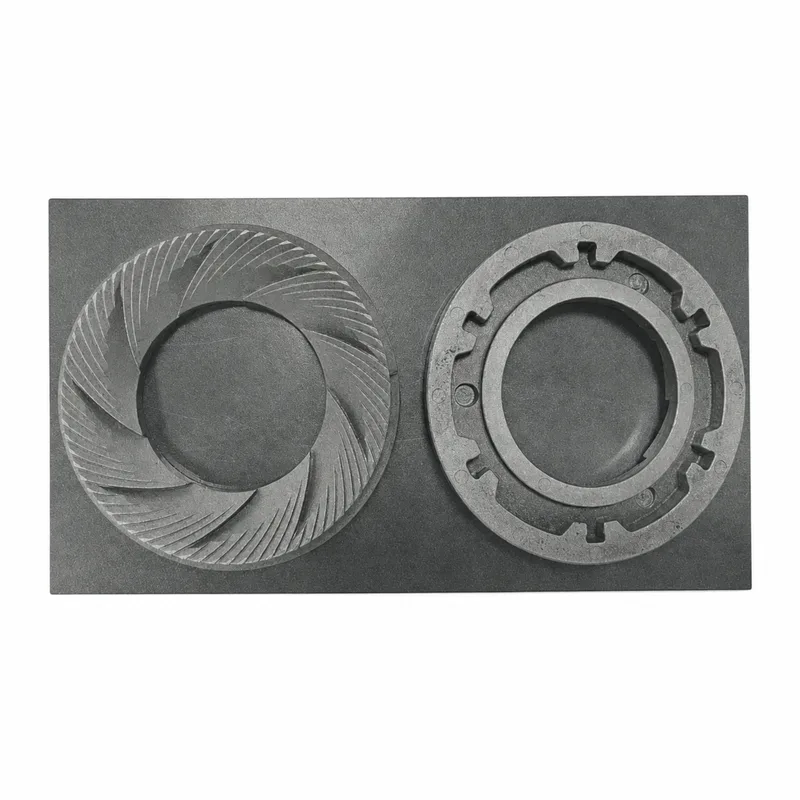
What replacement grinder components must match in an existing assembly
Review this component together with its mating parts and delivered condition. The interfaces below define the drawing information needed to assess forming, finishing and inspection.
A familiar outline alone is not enough to establish interchangeability.
Original drawing revision, measured sample and mating-part interfaces
Provide the original drawing revision or a measured sample with its mating parts.
Record tooth orientation, drive engagement and the assembled position of the replacement component.
Why freeze a drawing before reproducing a worn sample?
A used sample can contain wear or damage as well as its intended geometry.
An agreed drawing separates the design to reproduce from the condition observed on the sample.
It also gives both parties a consistent reference for evaluating the first replacement parts.
Reproducing original geometry through forming and finishing
Review whether the original geometry can be reproduced by the proposed forming and finishing sequence.
Sample-based development still needs an agreed drawing and acceptance plan.
The proposed route is confirmed for your drawing, material and quantity. An image does not establish a fixed tolerance or a complete process specification.
Compare manufacturing capabilities →Replacement grinder component material and cleaning requirements
Specify the required grade or performance criteria together with cleaning, wear and appearance requirements.
For any surface that contacts food or beverage, identify the applicable customer documentation and acceptance criteria.
A stainless label is not a complete contact specification.
Review material-selection information →Fit, centering and grinding-operation checks against the reference
Compare fit, centering and grinding operation with the approved reference assembly.
Document any differences before approving a replacement part for repeat supply.
Specify the drawing revision and the condition in which each dimension is inspected. Record the agreed dimensional and functional checks before sample approval.
Quality documentation →Prepare a Product-Specific RFQ
- Component definition. Send the 2D drawing and 3D model, where available, with the drawing revision and the requested part or assembly scope.
- Mating information. Include the assembly references needed to define the interfaces discussed above.
- Delivered condition. State material, finishing and inspection requirements, identifying any items that need a manufacturing recommendation.
- Supply plan. Include sample needs, expected order and annual quantities, packaging requirements and target timing.
Product Questions
Can an old sample replace a manufacturing drawing?
A sample can start the review, but critical dimensions, condition and acceptance requirements must be agreed before production.
Why freeze a drawing before reproducing a worn sample?
A used sample can contain wear or damage as well as its intended geometry. An agreed drawing separates the design to reproduce from the condition observed on the sample. It also gives both parties a consistent reference for evaluating the first replacement parts.
How should fit and operating behavior be approved?
Compare fit, centering and grinding operation with the approved reference assembly. Document any differences before approving a replacement part for repeat supply.
Technical Context
The product-specific notes above identify drawing-review questions. General process and material references are collected separately; they do not verify a material grade, production qualification or performance claim for the pictured part.
Manufacturing and material references →