What beverage-machine brackets and fittings support
Review this component together with its mating parts and delivered condition. The interfaces below define the drawing information needed to assess forming, finishing and inspection.
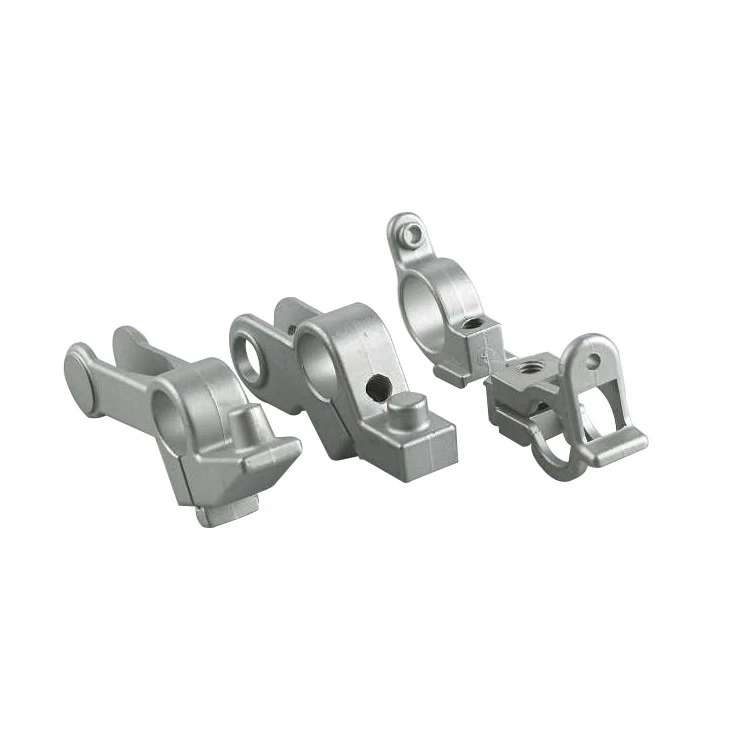
The reference shows several bracket-like forms with mounting features.
Mechanism-support versus beverage-contact interfaces
State whether the requested part supports a mechanism or directly contacts a beverage.
Define connection holes, contact faces and the mating arrangement before specifying cleaning requirements.
Why identify direct-contact surfaces individually?
A beverage machine contains both dry-side mechanisms and parts in the fluid path.
Their cleaning, surface and documentation requirements need not be identical.
Marking the actual role of each surface allows the project requirements to follow function rather than the broad machine category.
Separate process reviews for brackets and fluid-contact fittings
Evaluate integrated bosses and supports for near-net forming, retaining machining where a bore or seating face controls the assembly.
A bracket and a fluid-contact fitting need separate process reviews.
The proposed route is confirmed for your drawing, material and quantity. An image does not establish a fixed tolerance or a complete process specification.
Compare manufacturing capabilities →Beverage-machine grade, cleaning and fluid-contact requirements
Specify the required grade or performance criteria together with cleaning, wear and appearance requirements.
For any surface that contacts food or beverage, identify the applicable customer documentation and acceptance criteria.
A stainless label is not a complete contact specification.
Review material-selection information →Hole relationships, bracket seating and surface-condition checks
Inspect hole relationships, bracket seating and the final surface condition.
Agree any fluid-contact, cleaning or assembly verification from the actual component role.
Specify the drawing revision and the condition in which each dimension is inspected. Record the agreed dimensional and functional checks before sample approval.
Quality documentation →Where cost sits on beverage-machine brackets and fittings
A bracket and a fluid-contact fitting can look similar and be priced very differently, because one is judged on position and the other on what it puts into a drink. Splitting the two before quoting is the main cost decision.
| Cost element | Why a small order costs more per piece | Why a large order stops getting cheaper |
|---|---|---|
| The forming tool, per shape | Brackets and fittings rarely share a tool, even when they come in one enquiry. Each shape is its own tooling item and its own first article. | Tooling is one-off. Combining two similar parts into one tool is possible only if the geometry allows it, and that is a design decision rather than a volume effect. |
| Fluid-contact surface finishing | A wetted surface needs a finish that can be cleaned and, where specified, electropolished. That is a separate operation with its own handling. | Electropolishing is priced on area and load. It scales reasonably, but the operation does not disappear at any volume. |
| Cleaning and packing for food contact | Parts that touch a beverage are cleaned and packed to a stated standard, and the record of that is part of the delivery. | Cleaning is batched and scales well. The documentation that goes with it does not scale at all. |
| Welding or assembly, where a bracket is a set | A bracket often arrives as two formed pieces joined. Welding is per part and needs its own fixture. | Fixtures reduce set-up; the weld itself stays per part. Distortion control after welding is the recurring cost here. |
| Surface and cleanliness verification | Roughness on a wetted face and residue after cleaning both need checks that are hard to automate. | Sampling can be agreed, and roughness measurement is fast once a method is fixed. Neither gets cheaper with order size. |
Note. The split below describes cost structure, not prices. What a specific part costs depends on its geometry, material, finish and the quantity you can commit; this page explains which of those you can move and which you cannot.
The cost-relevant fact about a beverage-machine part is whether it is wetted. That single distinction decides the finish, the cleaning standard, the documentation and often the alloy. Sending both types in one enquiry without that split is the most common reason a quotation comes back vague.
Prepare a Product-Specific RFQ
- Component definition. Send the 2D drawing and 3D model, where available, with the drawing revision and the requested part or assembly scope.
- Mating information. Include the assembly references needed to define the interfaces discussed above.
- Delivered condition. State material, finishing and inspection requirements, identifying any items that need a manufacturing recommendation.
- Supply plan. Include sample needs, expected order and annual quantities, packaging requirements and target timing.
Product Questions
Do all beverage-machine metal parts contact the beverage?
No. Supports and actuation hardware may be outside the fluid path; identify direct-contact surfaces on the drawing.
Why identify direct-contact surfaces individually?
A beverage machine contains both dry-side mechanisms and parts in the fluid path. Their cleaning, surface and documentation requirements need not be identical. Marking the actual role of each surface allows the project requirements to follow function rather than the broad machine category.
How should fit and operating behavior be approved?
Inspect hole relationships, bracket seating and the final surface condition. Agree any fluid-contact, cleaning or assembly verification from the actual component role.
Technical Context
The product-specific notes above identify drawing-review questions. General process and material references are collected separately; they do not verify a material grade, production qualification or performance claim for the pictured part.
Manufacturing and material references →