
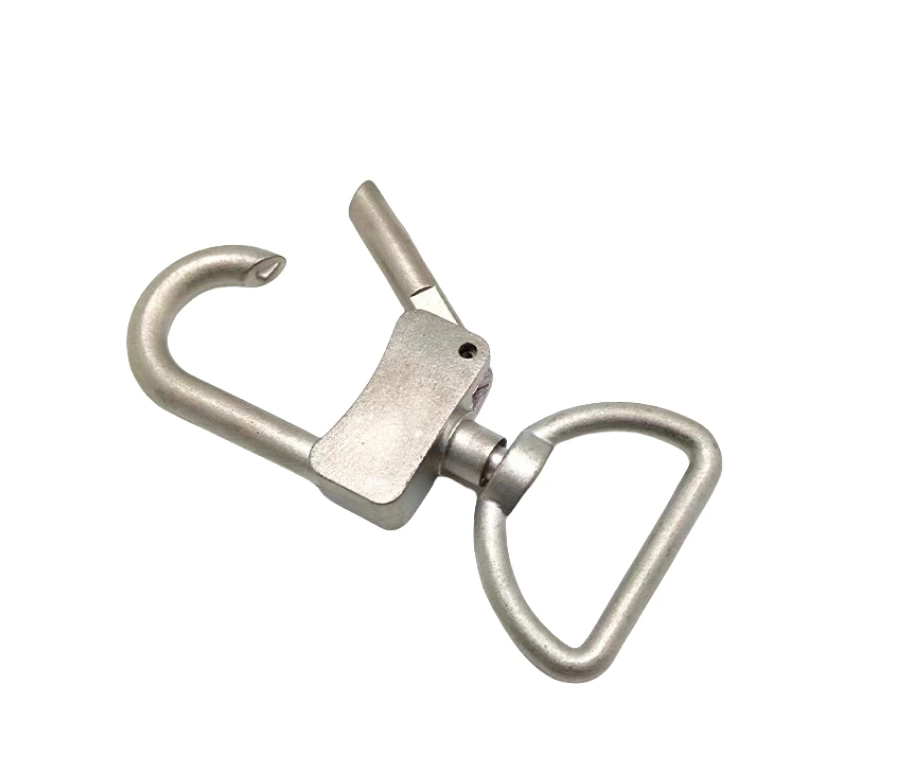
What a leash clip, swivel and loop combine in one assembly
Review this component together with its mating parts and delivered condition. The interfaces below define the drawing information needed to assess forming, finishing and inspection.
The reference is useful for defining individual metal parts and their interfaces, not a stated load rating.
Gate engagement, swivel connection and strap interfaces
Provide gate engagement, swivel connection and the mating strap or ring.
Identify load directions and whether moving members are part of the requested supply.
Why define the gate and swivel as separate interfaces?
The gate controls closure, while the swivel permits a different movement.
Both can affect the completed connection, but they require different checks.
Defining each interface avoids treating a general assembly appearance as evidence of closure or rotation performance.
Reviewing clip body, pin and rotating connection separately
Review the clip body, pin and rotating connection as separate manufacturing items.
Forming and machining may be combined, with final assembly defined explicitly.
The proposed route is confirmed for your drawing, material and quantity. An image does not establish a fixed tolerance or a complete process specification.
Compare manufacturing capabilities →Leash hardware alloy, contact and delivered-condition requirements
Specify the actual alloy or functional material requirements rather than relying on color or a trade name.
Specialty material requests need an individual process review.
Define visible surfaces, contact requirements and final dimensions in the delivered condition.
Review material-selection information →Closure, swivel movement and retention checks
Check closure, swivel movement, retention and the agreed assembly test.
Required load and durability levels must come from the project specification.
Specify the drawing revision and the condition in which each dimension is inspected. Record the agreed dimensional and functional checks before sample approval.
Quality documentation →What changes between lots on leash hardware
A clip is a small mechanism with a spring, a gate and a swivel in one assembly. Consistency depends on the parts moving as intended, and the parts that move are the ones that vary most.
| What drifts between lots | Where the drift comes from | What the release check catches |
|---|---|---|
| Gate closing position and spring force | The gate closes against a seat, and the spring is a separate item. A small change in the seat or in the spring rate changes how firmly the gate closes, and that is not visible in a dimensional check. | Check gate closure on an assembled part and record spring rate per lot. A gate that passes a visual check can still open under a load it is expected to hold. |
| Swivel rotation | The swivel is a rotating joint. Its freedom depends on the fit between pin and loop and on the surface finish inside both, and coating thickness changes that fit. | Check rotation torque or freedom on an assembled, coated part. A swivel that turned freely before plating can bind after it. |
| Pin and hole fit at the gate pivot | Both are small and both are finished, so the same tool wear direction that opens one closes the other. The joint moves from tight to loose across a run. | Gauge pin and hole as a pair, and check the gate action. Independent tolerances on a small joint rarely predict the assembled feel. |
| Coating thickness and corrosion resistance | Leash hardware is used outdoors and near water. Coating thickness varies with geometry and bath condition, and salt spray results follow thickness and coverage at the edges. | Require a corrosion test per lot at an agreed duration, and record the result. Appearance after plating is not a corrosion test. |
| Edge condition at the strap interface | Sharp edges cut webbing and cord. Deburring is a bulk operation whose result depends on media life, and a change of cycle shows first at the edges touching the strap. | Define the edge radius at the strap interface and inspect against a boundary sample. This is a safety-relevant edge, not a cosmetic one. |
Note. This describes how the process behaves across a production run, not the history of any particular lot. Acceptance values, sample sizes and inspection methods come from the project drawing and the agreed quality plan.
Three of these five are properties of the assembly rather than of a part, which is why they appear on no single-part drawing. Where the request arrives as an assembly photo, these are the items nobody has agreed to check.
Prepare a Product-Specific RFQ
- Component definition. Send the 2D drawing and 3D model, where available, with the drawing revision and the requested part or assembly scope.
- Mating information. Include the assembly references needed to define the interfaces discussed above.
- Delivered condition. State material, finishing and inspection requirements, identifying any items that need a manufacturing recommendation.
- Supply plan. Include sample needs, expected order and annual quantities, packaging requirements and target timing.
Product Questions
Does a clip photograph establish a suitable pet size or load?
No. The approved assembly design and test requirements must establish intended use and load limits.
Why define the gate and swivel as separate interfaces?
The gate controls closure, while the swivel permits a different movement. Both can affect the completed connection, but they require different checks. Defining each interface avoids treating a general assembly appearance as evidence of closure or rotation performance.
What should the project acceptance plan include?
Check closure, swivel movement, retention and the agreed assembly test. Required load and durability levels must come from the project specification.
Technical Context
The product-specific notes above identify drawing-review questions. General process and material references are collected separately; they do not verify a material grade, production qualification or performance claim for the pictured part.
Manufacturing and material references →