
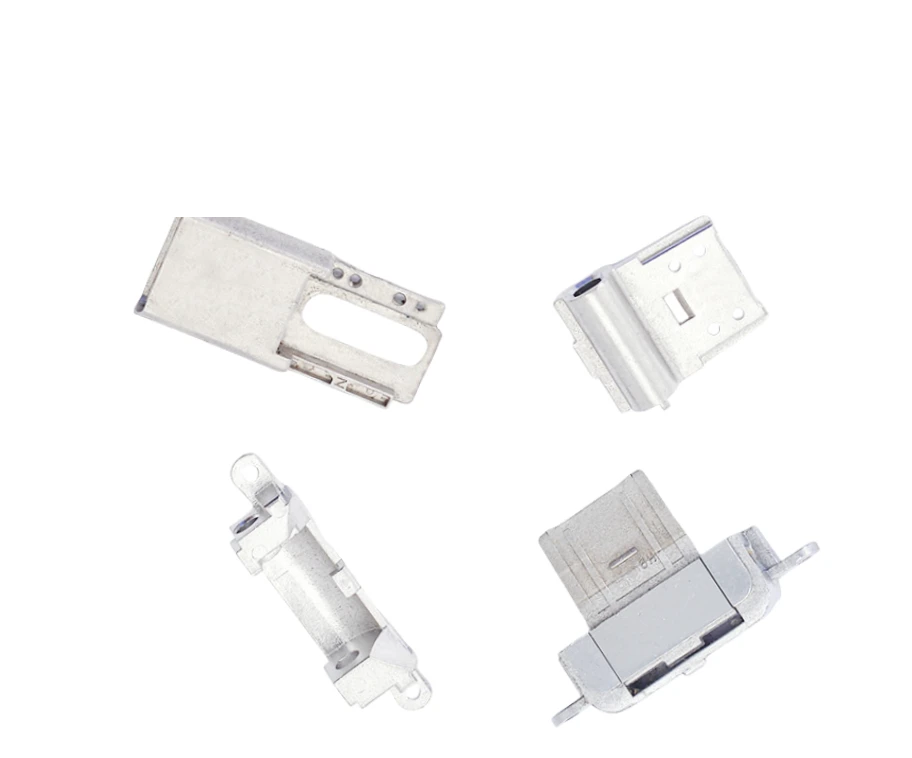
What lens mounting hardware provides around an optical assembly
Review this component together with its mating parts and delivered condition. The interfaces below define the drawing information needed to assess forming, finishing and inspection.
The reference includes several small forms with openings and support features.
Exact part, mating lens assembly and functional-datum interfaces
Specify the exact part, its mating lens assembly and the functional datums.
Do not use cosmetic outer contours as substitutes for alignment surfaces.
Why does a lens-related part need an exact supply definition?
A group photograph may show covers, supports or locating members with different roles.
The manufacturing requirements depend on which item is supplied and what it mates with.
An exact part boundary avoids treating an assembly reference as a single finished product.
MIM versus machining for integrated features and precision seats
Compare MIM and machining for integrated features and accessible precision seats.
The manufacturing plan should explain how the critical mounting relationships are established.
The proposed route is confirmed for your drawing, material and quantity. An image does not establish a fixed tolerance or a complete process specification.
Compare manufacturing capabilities →Lens hardware base material and finish requirements
Define base material, final condition and cosmetic finish separately.
Identify visible faces, permitted edge rounding and the dimensions that must be met after finishing.
Any magnetic, electrical or acoustic requirement needs its own specification.
Review material-selection information →Opening, locating-seat and attachment-feature checks
Inspect openings, locating seats and attachment features.
Any optical alignment or dust-protection requirement needs an assembly-level acceptance method.
Specify the drawing revision and the condition in which each dimension is inspected. Record the agreed dimensional and functional checks before sample approval.
Quality documentation →Prepare a Product-Specific RFQ
- Component definition. Send the 2D drawing and 3D model, where available, with the drawing revision and the requested part or assembly scope.
- Mating information. Include the assembly references needed to define the interfaces discussed above.
- Delivered condition. State material, finishing and inspection requirements, identifying any items that need a manufacturing recommendation.
- Supply plan. Include sample needs, expected order and annual quantities, packaging requirements and target timing.
Product Questions
Is the pictured hardware a complete lens cap or lens mount?
It is a component reference group. Identify the individual part and assembly scope in the inquiry.
Why does a lens-related part need an exact supply definition?
A group photograph may show covers, supports or locating members with different roles. The manufacturing requirements depend on which item is supplied and what it mates with. An exact part boundary avoids treating an assembly reference as a single finished product.
How are appearance and functional fit checked?
Inspect openings, locating seats and attachment features. Any optical alignment or dust-protection requirement needs an assembly-level acceptance method.
Technical Context
The product-specific notes above identify drawing-review questions. General process and material references are collected separately; they do not verify a material grade, production qualification or performance claim for the pictured part.
Manufacturing and material references →