
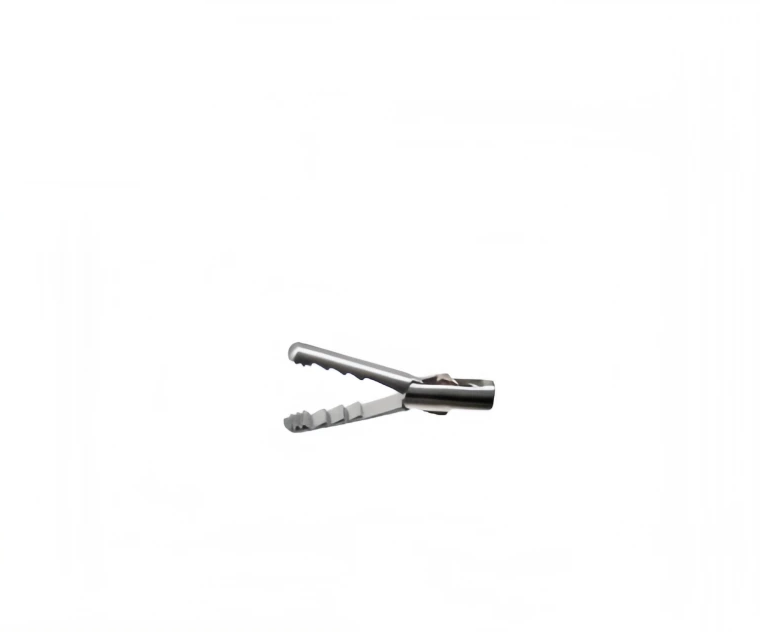
MIM appears throughout medical device hardware: instrument jaws, forceps components, endoscopic parts, gear and linkage elements, sensor housings and diagnostic equipment components. The reason is the same as in other precision sectors — small, intricate, three-dimensional geometry produced in repeatable volume.
What differs in medical work is the surrounding requirement set. Material, surface condition, cleanliness and documentation are specified by the device manufacturer and its regulatory pathway, and they constrain the process in ways that general industrial parts do not.
Start with the part's function and duty
Medical device hardware spans a wide range of duty. At one end sit non-patient-contacting components — equipment housings, actuator parts, pump and valve internals, diagnostic instrument mechanisms. At the other sit components that touch the patient directly, and beyond that, components intended to remain in the body.
These categories carry very different requirement sets, and the differences are not gradual. A non-contacting equipment component may be treated much like any precision industrial part. A part that contacts the patient is subject to the device manufacturer's validation and to the applicable regulatory pathway, with requirements covering material identity, biocompatibility, surface condition and cleaning or reprocessing.
Establishing which category the part falls into is therefore the first task — before geometry, before material, before any tooling discussion. Getting that wrong wastes time at both ends.
Where MIM fits
- Instrument components — jaw and forceps elements, ratchet and locking parts, pivots, linkages and small structural components with complex geometry.
- Endoscopic and minimally invasive hardware — small parts where the geometry is three-dimensional and part-to-part consistency matters.
- Diagnostic and laboratory equipment — mechanism components, gear elements, carriers and housings in analysers and sample handling equipment.
- Device hardware — sensor components, actuator parts and mounting hardware where repeatability of position drives the specification.
- Non-embedded housings and brackets with integrated features that would otherwise be assembled from several pieces.
What these share is the geometry story that makes MIM attractive generally: small, feature-rich, three-dimensional parts at repeat volume, where machining would involve multiple setups and significant material removal.
Material selection
Two grades account for the majority of medical MIM components.
316L
The default choice for instrument and device hardware. Good corrosion resistance, tolerant of repeated cleaning, well understood and reliably sintered to 95–99% of theoretical density. Typically passivated after sintering and finishing to restore the passive oxide layer. Non-hardenable, so it is not suitable for a cutting edge or a heavily loaded rubbing surface.
17-4PH
Used where higher strength or hardness is needed, aged to roughly HRC 30–40 depending on the treatment. Common in instrument mechanisms, ratchets and parts that must resist wear while retaining useful corrosion resistance. It requires the aging treatment to be specified and verified, since the solution-annealed condition is considerably softer.
Titanium alloys
Titanium grades offer a high strength-to-weight ratio and excellent corrosion resistance, and they are relevant where weight or material compatibility is part of the requirement. They are project materials: feedstock, sintering atmosphere and process window differ from stainless work, and the achievable properties should be established for the specific application rather than assumed.
Material identity is a documented requirement in medical programs. The device manufacturer's quality system typically expects material certificates with lot identification that ties each production lot back to its powder source. This is a supply chain and records requirement as much as a metallurgical one, and it should be confirmed before a program is quoted.
Finish and cleanliness
Post-sintering finishing in medical work is usually about surface condition as much as appearance. Common operations include:
- Tumbling and vibratory finishing — to remove flash and round edges, reducing the risk of surface damage and improving cleanability.
- Passivation — standard for stainless parts, removing free iron and surface contamination so the passive layer forms cleanly.
- Electropolishing — where a smoother, more uniform surface is specified; it removes a small amount of material and improves surface topography.
- Machining of critical features — bores, pivot holes and sealing surfaces that need tolerances beyond as-sintered capability.
- Cleaning and packaging — specified according to the assembly environment, which may range from ordinary industrial handling to a controlled cleanroom process.
The requirement that is most often missing from an initial enquiry is the surface condition specification. "Clean" and "smooth" are not measurable, and they do not tell a supplier which operation to apply. Roughness values, or a reference to an existing component, give something actionable.
Validation, traceability and regulation
For components that form part of a medical device, the requirement set is defined by the device manufacturer and the applicable regulatory pathway rather than by the component supplier. In practice this means the supplier is asked to support validation rather than to certify a finished device.
What that support typically includes: lot identification and traceability from powder through to shipped parts; material certificates; dimensional inspection records against the drawing; density and hardness data where specified; process parameters and any changes to them; and a documented change-control process so that the device manufacturer is informed before a process, material or supplier change is made.
Implantable and patient-contacting applications require project-specific material selection, validation and regulatory review. The appropriate material, surface condition and documentation depend on the specific device, its intended use and its approval pathway. These are matters for the device manufacturer and its regulatory process, and they should be discussed as a project rather than treated as an extension of a standard component order.
What MIM does not do
- It does not qualify a device. Component supply supports the device manufacturer's validation; it does not substitute for it.
- It does not make a soft grade hard. 316L cannot be hardened, so a wear-critical instrument feature needs a different grade or a coating.
- It does not guarantee a surface finish without process control. Residual porosity affects achievable finish, so finish requirements and density should be specified together.
- It does not suit large or thick-walled parts. The practical mass range and wall-section limits apply in medical work as everywhere else.
- It does not replace machining on tolerance-dominated drawings. Where most dimensions need ±0.02 mm, the part belongs on a machine, possibly as a hybrid with a formed blank.
What to share for a first review
A medical component enquiry is most productive when it states: the drawing and STEP model; the component's function and whether it contacts the patient or is implanted; the material requirement or the performance requirement if the grade is open; the finish and cleanliness specification; the annual volume and program life; the documentation the device manufacturer requires; and any regulatory or quality standard the component must support.
The two fields most often omitted are the patient-contact status and the documentation requirement. Both change the conversation substantially, and both are cheaper to raise at the start than to retrofit into a program that is already in tooling.
Material specification and its limits. Where a medical instrument component is specified, the material itself can be pinned to a published reference: ASTM B883-24 covers MIM ferrous materials, MPIF Standard 35-MIM — Materials Standards for Metal Injection Molded Parts lists the mechanical and physical properties of the common MIM material families, and ISO 5755:2022 covers sintered metal material specifications more broadly. What these standards do not do is establish suitability for a clinical use. Implant and patient-contacting applications require project-specific material selection, verification and regulatory review, and that determination remains with the device manufacturer.
Conclusion
MIM is well established in medical device hardware because the geometry problem it solves — small, intricate parts produced in repeatable volume — is common in instrument and equipment design. The process performs reliably in this sector when material, finish and documentation requirements are treated as design inputs.
Where the application involves patient contact or implantation, the material and validation path is defined by the device manufacturer and its regulatory process, and it should be addressed as a project-specific question from the outset. Approached that way, MIM is a capable and well-understood route for medical component manufacturing.
Related component families
These pages cover the component families that appear most often in medical device programs.
Medical Device Components
Instrument, diagnostic and device hardware produced by MIM and precision machining.
Component guide →Precision Small Components
Small parts where repeatability across production lots is the governing requirement.
Component guide →Mechanism Components
Jaws, linkages and ratchet parts where geometry complexity drives the route.
Component guide →Quality System
Measurement, records and change control behind component supply.
Quality overview →Have a drawing to discuss?
Send it to our engineering team. We review process fit and identify the information needed for a quotation.
Send Drawing for Review