
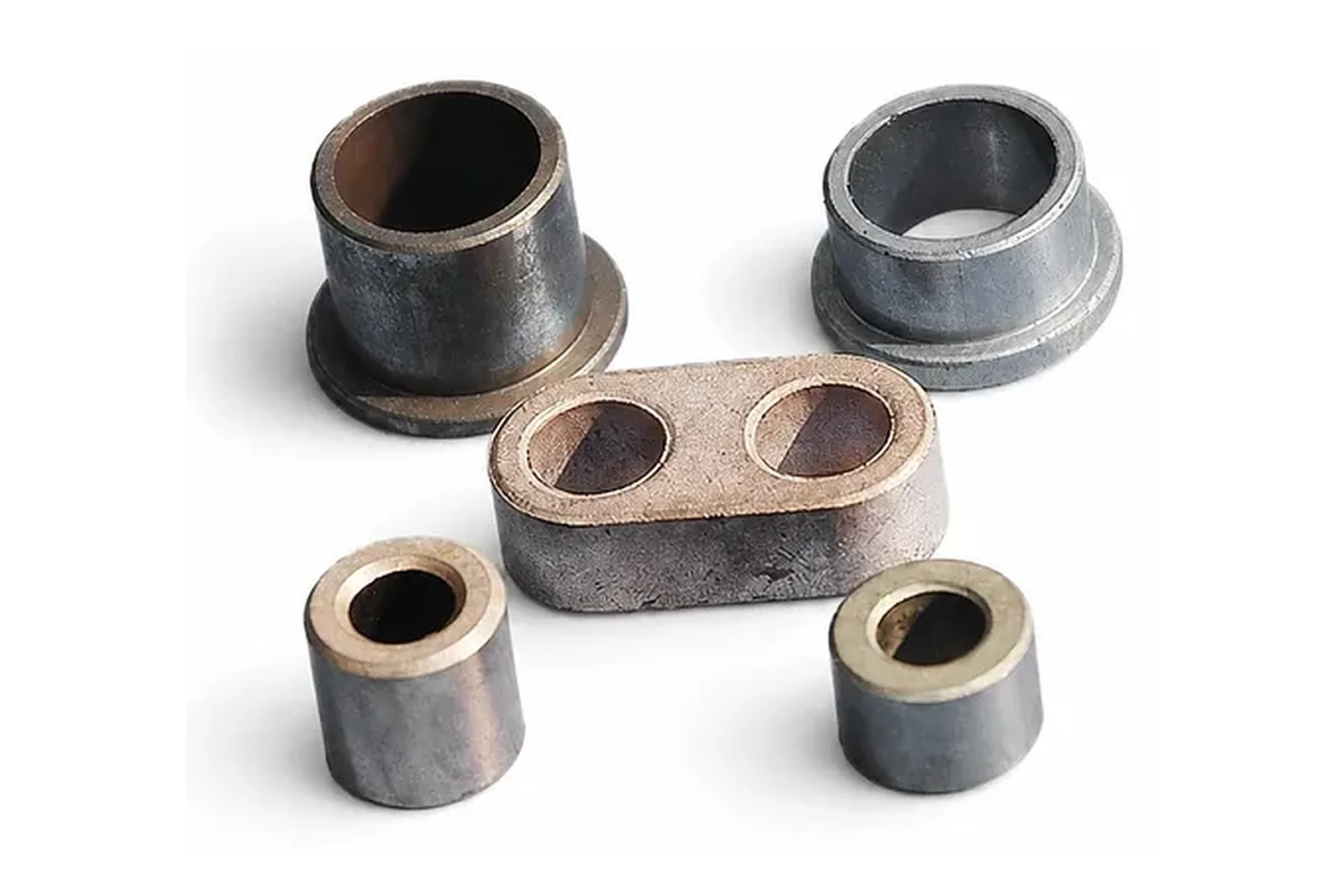
Material selection in MIM is often treated as a late-stage formality — pick the grade closest to what the previous supplier used, then move on. That habit causes more program problems than any geometry issue, because a sintered grade's properties depend on composition, density and heat treatment together, and not all combinations are available.
This guide sets out the grades that account for the large majority of MIM work, the properties each one actually delivers, and the three or four questions that normally settle the choice.
Why material choice drives the program
In a sintered part, three variables interact to produce the final properties: composition, density and heat treatment. Composition comes from the powder. Density comes from the sintering process window. Hardness and strength come from heat treatment where the grade allows it.
That interaction is why a material decision made early binds everything downstream. Choose 316L and the part cannot be hardened later, so wear resistance has to come from a coating or a design change. Choose a low-alloy steel and corrosion resistance becomes a finishing question. Choose a soft-magnetic alloy and carbon content must be controlled more tightly than the drawing's general tolerances would suggest.
The practical consequence: decide the material before tooling is cut, not after the first samples fail a test.
Start from the application, not the grade
Four questions resolve most material decisions, in this order.
- Is corrosion resistance the governing requirement? If the part sees moisture, chemicals, or a marine or medical environment, the answer starts with a stainless grade.
- Does the part need to resist wear or carry load? That points to a hardenable or alloy steel, or to 17-4PH, rather than to 316L.
- Does the part interact with a magnetic field? Sensors, solenoids and actuators need soft-magnetic grades with controlled carbon.
- Is there a regulatory or biocompatibility requirement? Those narrow the field quickly and should be raised first, not last.
Stainless steels
Stainless grades dominate MIM production, and within them 316L and 17-4PH account for most of the volume. Both are well understood and reliably sintered.
316L — the general-purpose choice
Final sintered density depends on feedstock and processing. Use the documented SINTS material references for initial comparison, then agree the required final density and test method for the project.
17-4PH — strength and hardness
Martensitic precipitation-hardening stainless. It offers a good combination of corrosion resistance and mechanical strength, and it responds to aging treatment, typically reaching HRC 30–40 depending on the aging temperature and time. Common in mechanism parts, valve components, surgical instrument parts and applications where 316L is simply too soft.
420 and 440C — wear resistance
Martensitic grades with higher carbon, used where hardness and wear resistance are the primary requirements. 440C can reach HRC 58–60 after hardening and is used for cutting edges and wear surfaces. Corrosion resistance is lower than 316L, and the higher carbon content makes the sintering window narrower — these grades need a supplier who works with them regularly.
304L — where 316L is not required
Similar to 316L without the molybdenum addition. Slightly lower corrosion resistance and slightly lower cost. A reasonable choice for mildly corrosive environments where the molybdenum is not needed.
Low-alloy and structural steels
Where corrosion resistance is not the governing requirement, low-alloy steels deliver more strength per unit cost. They are heat treatable and are common in mechanism and structural parts.
- Fe-Ni alloys (for example Fe-2Ni, Fe-8Ni) — nickel additions improve hardenability and toughness. Used for structural components that will be quenched and tempered.
- Chromium-molybdenum steels — the sintered equivalents of alloys such as 4140, used where through-hardening and fatigue resistance matter.
- Carbon steels — the lowest-cost structural option, suitable where hardness after treatment is the only requirement and corrosion is managed by coating.
The trade-off is obvious: these grades rust. If the part sees moisture, either the grade changes to stainless or a plating, black oxide or PVD coating is added — and that decision belongs in the RFQ, not in a later revision.
Soft-magnetic alloys
Magnetic applications use a separate family, selected for permeability, saturation induction and low core loss rather than for mechanical strength.
- Fe-3Si — silicon iron, used for AC magnetic circuits where core loss matters. The higher silicon content increases resistivity and reduces eddy current losses.
- Fe-50Ni — high-permeability nickel iron, used for sensitive magnetic circuits in sensors and shielding.
- 430L-type ferritic stainless — a compromise where some corrosion resistance is needed alongside magnetic response.
Carbon and impurity control is critical in magnetic grades. Small amounts of carbon or oxygen degrade magnetic response disproportionately. If the part is a core or an armature, say so at RFQ stage — a supplier who treats it as an ordinary structural part may deliver a dimensionally correct component with disappointing magnetic performance.
Project materials: titanium and tungsten alloys
These are available but are genuinely project-specific. Titanium alloys such as Ti-6Al-4V offer high strength-to-weight ratio and excellent corrosion resistance, with density around 4.4 g/cm³, and are relevant where weight and biocompatibility matter. Tungsten heavy alloys reach densities of 17–18 g/cm³ and are used for counterweights, vibration damping and radiation shielding where mass in a small volume is the point.
Both need early discussion: the powder feedstock, sintering atmosphere and process window differ substantially from stainless work, and tooling decisions should follow, not precede, that conversation.
SINTS material reference data
| Documented grade | What to review | Next step |
|---|---|---|
| 316L, 316 and 304 | Corrosion exposure, final density, finish and cleaning conditions. | Use the material library; confirm the selected grade and condition. |
| 17-4PH | Strength, aging condition, hardness and corrosion requirements. | Agree heat treatment and acceptance values. |
| 420 / 410 and 440C | Wear, hardness, corrosion and final surface condition. | Confirm grade, treatment and inspection method. |
| MIM 4605 and MIM 4140 | Strength, hardness, heat treatment and corrosion protection. | Compare the documented sintered and heat-treated references. |
| HK30 and FeSi 3.0 | Application-specific properties and the final material condition. | Provide the required properties for review. |
| Other alloys | Exact alloy, powder availability, forming route and validation. | Confirm support for the project before tooling. |
These ranges are a starting point for feasibility discussions. Actual values depend on powder specification, density achieved and heat treatment; they should be confirmed on the drawing and verified on first article samples.
How material affects sintering and shrinkage
Different alloys shrink differently. The nominal 15–20% linear shrinkage figure spans a real spread: higher alloy content and higher powder loading tend to reduce shrink, while finer powders and lower solid loading increase it. Tooling is cut to compensate for the specific feedstock, which is why changing material mid-programme is not a paperwork exercise — it usually means a new mould.
Material also affects the practical design envelope. Ferritic and martensitic grades are more sensitive to carbon control and can be harder to sinter to full density than austenitic 316L. Magnetic grades need tighter atmosphere control. These are reasons to engage the supplier on material selection early, while the design can still respond.
Specifying material in an RFQ
A material specification that produces a useful quotation names five things:
- The grade — 316L, 17-4PH, 440C, Fe-50Ni and so on.
- Minimum density — for example 95% of theoretical, or a g/cm³ figure where the application demands it.
- Required heat treatment and resulting hardness range, if any.
- Corrosion or service environment, in one sentence.
- Any standard the material must satisfy — a material specification, a customer standard, or a regulatory reference.
A drawing that says only "stainless steel" will produce a quote on 316L, which may or may not be what the application needs. A drawing that says "316L, 95% minimum density, passivated, for a medical instrument handle cleaned with alcohol wipes" lets the supplier confirm fit and price it accurately.
Common material mistakes
- Specifying 316L and then asking for wear resistance. 316L does not harden. The requirement needs a different grade or a coating.
- Leaving density unspecified on a pressure or fatigue part. Residual porosity becomes a leak path or a crack initiation site.
- Choosing a hardenable grade without specifying the heat treatment. 17-4PH in the solution-annealed condition is far softer than the same alloy aged.
- Treating magnetic grades as ordinary steel. Carbon and oxygen limits are tighter, and the process window is narrower.
- Changing material after tooling. Shrinkage changes, and the mould usually has to change with it.
Where the property values come from. Material families described in this guide are standardised, not proprietary. MPIF Standard 35-MIM — Materials Standards for Metal Injection Molded Parts publishes the mechanical and physical properties for the common MIM material families, and ASTM B883-24 specifies the requirements for MIM ferrous materials. Ferrous grades also carry UNS numbers that make a specification unambiguous: 316L is UNS S31603 and 17-4PH is UNS S17400. ISO 5755:2022 covers the wider sintered metal material families. When a project needs a property value to be contractually meaningful, it should be traced to one of these rather than to a trade name.
Conclusion
Most MIM programs choose among about six grades. 316L covers general corrosion resistance, 17-4PH covers strength and hardness, the martensitic grades cover wear, low-alloy steels cover cost-sensitive structural work, and the soft-magnetic alloys cover anything that interacts with a magnetic field. Titanium and tungsten are available but are project conversations.
The discipline that prevents trouble is to specify property alongside grade — density, hardness, corrosion environment and any standard — and to settle it before tooling. Material is the cheapest decision to make early and one of the most expensive to change later.
Related component families
These pages show how material requirements interact with actual component families.
Gears and Transmission
Where hardenability and wear resistance normally set the material choice.
Component guide →Cutting and Wear Parts
Hardened martensitic grades for edges and surfaces that see abrasion.
Component guide →Mechanism Components
Parts where 17-4PH or low-alloy steel typically replaces 316L on strength grounds.
Component guide →Custom OEM Components
Programs where the grade is specified by the end customer and must be verified.
Component guide →Have a drawing to discuss?
Send it to our engineering team. We review process fit and identify the information needed for a quotation.
Send Drawing for Review