
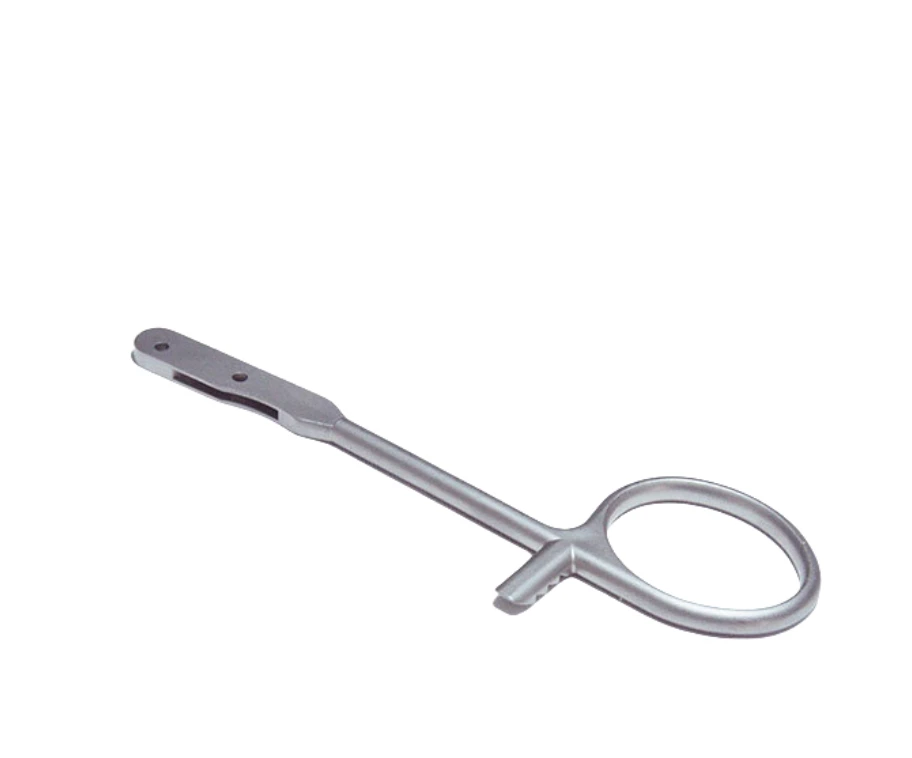
What a ring handle provides between hand and mechanism
The reference shows an individual elongated member rather than a complete qualified instrument.
Pivot connection, hand opening and instrument interfaces
Define the pivot or connection, the hand opening and the mating instrument parts.
Separate operating contacts from user-contact edges and cosmetic surfaces.
Why distinguish the hand opening from the mechanical connection?
The opening provides a user interface, while the connection relates the handle to the instrument mechanism.
Their edge, location and finish requirements can differ.
Defining each separately gives inspection a clearer purpose than one general handle-size description.
Forming versus machining for handle geometry
Compare forming and machining for the handle geometry and attachment features.
Long transitions and critical holes need attention to support, finishing and final inspection.
Compare manufacturing capabilities →Ring handle material, surface and traceability requirements
Provide the material specification, final surface requirements and documentation needed for the component.
Include your cleaning and traceability requirements and the checks you need us to document.
Tell us which component records your device qualification requires.
Review material-selection information →Ring handle: separating the hand link from the mechanism link
A handle has two chains that meet in one part. One runs from the hand to the grip surface, the other from the pivot to the instrument. Treating them as one chain is how a handle ends up comfortable and misaligned.
| Link in the assembly chain | What it adds to the stack | Where to take it out of the chain |
|---|---|---|
| Hand opening | The opening is sized for a hand and a glove, so its link is a clearance with a wide band. Its position relative to the instrument, however, is not wide at all. | Tolerance the opening generously and its position tightly. A single note covering the opening and its location forces both into one band and one of them will be wrong. |
| Pivot or connection | The pivot is where the two chains meet, so any error here appears in both. It is the only link that cannot be given away to either side. | Make the pivot the primary datum for the whole part. Everything else, including the hand opening, is then referenced to the point the instrument actually rotates about. |
| Instrument interface | This link carries the fit to the working end. On a reusable instrument it also carries wear from repeated cleaning and assembly. | State the interface as a fit rather than as two independent dimensions. A fit survives a change of supplier; two dimensions do not. |
| Grip surface and edge condition | The grip link is felt rather than measured. Its variation shows up as a handle that is comfortable in one unit and sharp in the next, with both inside their drawings. | Specify edge condition as a band with an inspection method, not as a single word. A note that says deburr cannot be accepted or rejected consistently. |
| Material record and traceability | For a medical part the record is part of the chain. A dimension without a traceable material lot cannot be accepted into a device file. | Confirm what the device file requires before the route is chosen. This is the one link where the requirement comes from outside the drawing, and it can change the process. |
The assembly designer sets the tolerance allocation. Mark the controlling dimensions on the component drawing.
The habit that pays on instrument parts is to draw the two chains separately and then mark where they share a feature. Almost always they share exactly one, and that one feature deserves to be the datum for everything else.
Connection fit, alignment and edge checks
Check connection fit, alignment, edges and the specified finish.
Include material, cleaning and traceability requirements in the project documentation.
Quality documentation →What to include in your enquiry
- Drawing and mating dimensions.Define the pivot or connection, the hand opening and the mating instrument parts. Include the drawing revision.
- Mating information. Include the assembly references needed to define the interfaces discussed above.
- Delivered condition. State material, finishing and inspection requirements, identifying any items that need a manufacturing recommendation.
- Supply plan. Include sample needs, expected order and annual quantities, packaging requirements and target timing.
- First-sample inspection.Check connection fit, alignment, edges and the specified finish. Specify the mating part or inspection fixture.
Common questions
Does an instrument handle quotation cover the complete device?
No. Identify the supplied component and any assembly work; device-level approval remains a separate project requirement.
Why distinguish the hand opening from the mechanical connection?
The opening provides a user interface, while the connection relates the handle to the instrument mechanism. Their edge, location and finish requirements can differ. Defining each separately gives inspection a clearer purpose than one general handle-size description.
What must the sample approval requirements define?
Check connection fit, alignment, edges and the specified finish. Include material, cleaning and traceability requirements in the project documentation.