
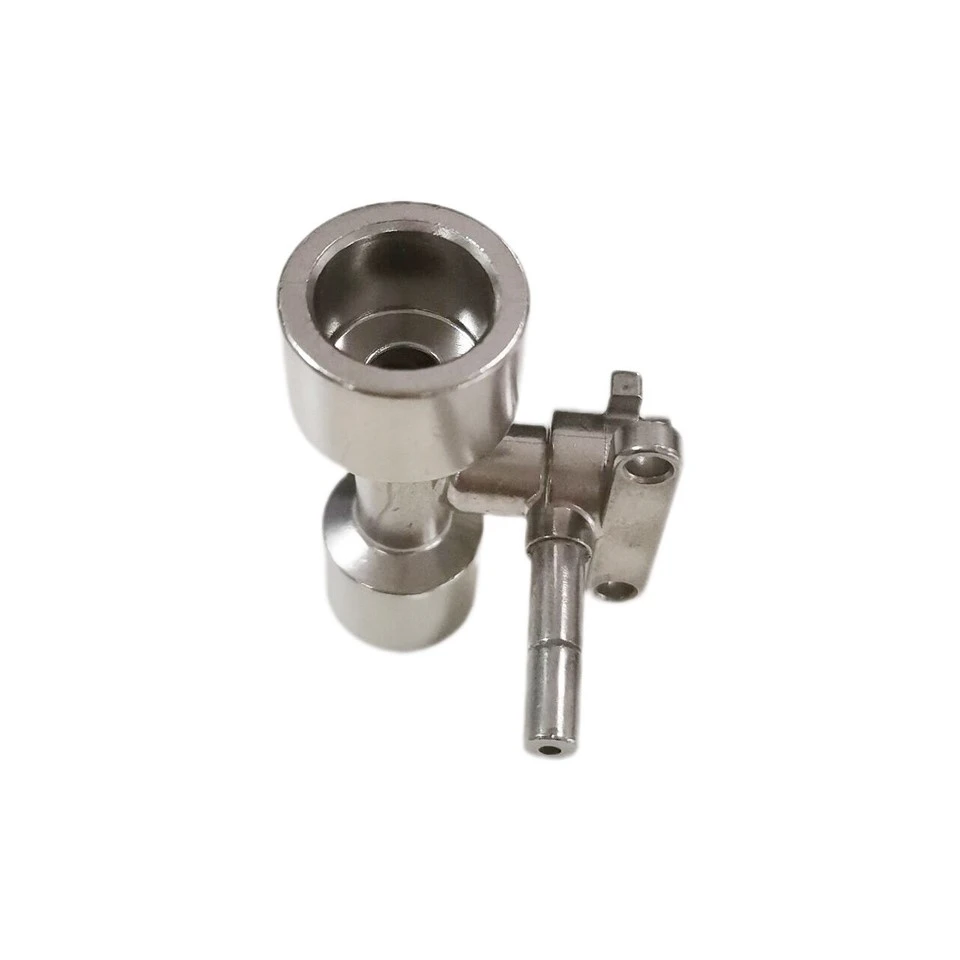
What sports equipment connection hardware joins and locates
Review this component together with its mating parts and delivered condition. The interfaces below define the drawing information needed to assess forming, finishing and inspection.
The reference shows an assembled connection and should be broken into individual components for quoting.
Retention, adjustment and external-load interfaces
Specify what the connection retains, how it adjusts and where the external load enters.
Threads, stops and clamping surfaces must be considered with the mating member.
Why does a swivel or adjustment connection need an assembly view?
A connection can contain several members with different roles: one locates, another retains, and another permits adjustment.
An assembly view explains which interfaces must move and which must remain fixed.
That distinction guides both the manufacturing split and the acceptance test.
Forming the body with separate pin and screw production
Compare forming and machining of the body with separate production of pins or screws.
A complete assembly may require multiple routes and an agreed joining sequence.
The proposed route is confirmed for your drawing, material and quantity. An image does not establish a fixed tolerance or a complete process specification.
Compare manufacturing capabilities →Connection hardware alloy, contact and delivered-condition requirements
Specify the actual alloy or functional material requirements rather than relying on color or a trade name.
Specialty material requests need an individual process review.
Define visible surfaces, contact requirements and final dimensions in the delivered condition.
Review material-selection information →Adjustment travel, retention and thread checks
Check adjustment travel, retention interfaces, threads and the agreed load or operating test.
No load rating is established by the product image.
Specify the drawing revision and the condition in which each dimension is inspected. Record the agreed dimensional and functional checks before sample approval.
Quality documentation →Prepare a Product-Specific RFQ
- Component definition. Send the 2D drawing and 3D model, where available, with the drawing revision and the requested part or assembly scope.
- Mating information. Include the assembly references needed to define the interfaces discussed above.
- Delivered condition. State material, finishing and inspection requirements, identifying any items that need a manufacturing recommendation.
- Supply plan. Include sample needs, expected order and annual quantities, packaging requirements and target timing.
Product Questions
Can a load rating be taken from the size of the fitting?
No. Rating requires the complete design, material condition, assembly and agreed verification, not an appearance comparison.
Why does a swivel or adjustment connection need an assembly view?
A connection can contain several members with different roles: one locates, another retains, and another permits adjustment. An assembly view explains which interfaces must move and which must remain fixed. That distinction guides both the manufacturing split and the acceptance test.
What should the project acceptance plan include?
Check adjustment travel, retention interfaces, threads and the agreed load or operating test. No load rating is established by the product image.
Technical Context
The product-specific notes above identify drawing-review questions. General process and material references are collected separately; they do not verify a material grade, production qualification or performance claim for the pictured part.
Manufacturing and material references →