
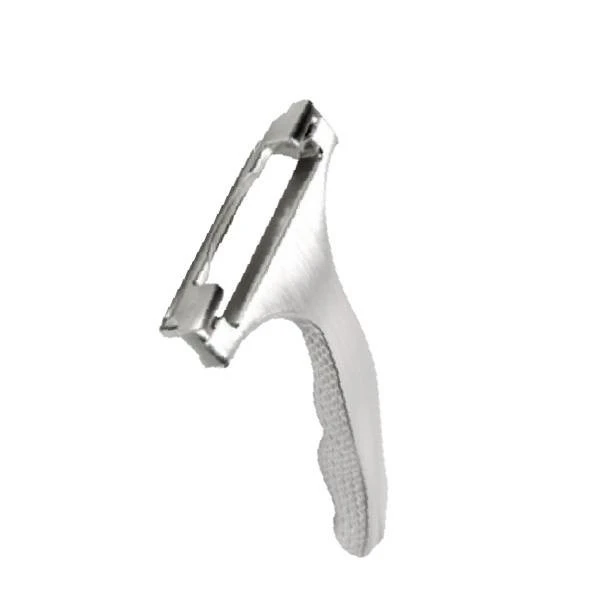
What a razor handle connects between the hand and head
Review this component together with its mating parts and delivered condition. The interfaces below define the drawing information needed to assess forming, finishing and inspection.
The reference combines a shaped grip with attachment features; the scope of the head connection must be agreed separately.
Head attachment, handle orientation and grip-envelope interfaces
Define the head attachment, handle orientation and grip envelope.
Separate visible surfaces from threads, seats or other functional connections.
Mark which edges may be rounded during polishing and which must retain their drawing geometry.
Why define the head connection before the grip finish?
The head connection establishes the handle's functional alignment, while the grip is primarily the hand-contact and appearance region.
Establishing the connection first identifies the features cosmetic processing must preserve.
The finished sample can then be checked for both fit and the agreed grip surface.
Machining versus MIM for razor handle geometry
Compare machining for straightforward turned or milled features with MIM or another forming route for integrated handle geometry.
The quotation should identify how the connection is finished and how the body is held during polishing or texture preparation.
The proposed route is confirmed for your drawing, material and quantity. An image does not establish a fixed tolerance or a complete process specification.
Compare manufacturing capabilities →Stainless grade, grip finish and functional-edge requirements
Specify the stainless grade and the required finished appearance for the handle.
Separate polished or textured grip regions from the head connection, and mark functional edges that must be preserved.
Cleaning products and wet-use conditions should inform the material and surface review; color or gloss is not a corrosion specification.
Review material-selection information →Head fit, alignment and grip-edge checks
Check head fit, alignment, grip edges and the agreed surface appearance in the finished condition.
Include wet-use and cleaning conditions when specifying material and finish, and approve the handle with the intended mating head.
Specify the drawing revision and the condition in which each dimension is inspected. Record the agreed dimensional and functional checks before sample approval.
Quality documentation →Razor handles: thread, balance point and the surfaces you touch
A razor handle is bought on feel and returned on a loose head. The thread that joins handle to head, the mass distribution along the grip and the finish on the surfaces that contact skin and water are the three requirements that decide whether it works, and they are reviewed separately.
| Feature | What it governs | How it is specified and verified |
|---|---|---|
| Head thread form and engagement | Whether the head stays tight through shaving and whether repeated changes wear the thread. | Thread by form, pitch and class, plus engagement length; thread gauge check after finishing, since plating changes the fit. |
| Thread axis to the handle end face | Whether the head sits square, which the user feels immediately as a tilted blade. | Squareness of the thread axis to the end face; CMM on the finished part. |
| Mass distribution along the grip | Balance in the hand, and whether the handle feels head-heavy. | Wall thickness or core geometry by section, with a target mass and tolerance; weighed per batch. |
| Grip surface and finish by zone | Hand feel, cleanability and whether the finish survives soap and water. | Finish callouts separated for grip, thread and end faces; adhesion and appearance checks on the finished part. |
| Seam, gate and ejector marks | Whether a visible mark lands where the user will see it every day. | Gate and ejector positions agreed at DFM against the cosmetic acceptance criteria; marks on hidden faces only. |
Note. All dimensions and acceptance criteria are taken from the project drawing. The table lists the points that get reviewed; it does not fix values.
A plain cylindrical handle with a single thread is a turned part, and moulding it adds cost without adding capability. The case for MIM is a hollow or cored body with an integrated thread, a shaped grip and a decorative end, which would otherwise be three pieces joined together. Where the wall has to be very thin for balance, the moulding route struggles and a drawn tube plus a machined insert is the more reliable build.
Prepare a Product-Specific RFQ
- Component definition. Send the 2D drawing and 3D model, where available, with the drawing revision and the requested part or assembly scope.
- Mating information. Include the assembly references needed to define the interfaces discussed above.
- Delivered condition. State material, finishing and inspection requirements, identifying any items that need a manufacturing recommendation.
- Supply plan. Include sample needs, expected order and annual quantities, packaging requirements and target timing.
Product Questions
Can the grip finish and head connection be approved separately?
Yes, but the final sample must also be checked after finishing so that cosmetic processing has not changed the attachment or alignment.
Why define the head connection before the grip finish?
The head connection establishes the handle's functional alignment, while the grip is primarily the hand-contact and appearance region. Establishing the connection first identifies the features cosmetic processing must preserve. The finished sample can then be checked for both fit and the agreed grip surface.
What should the project acceptance plan include?
Check head fit, alignment, grip edges and the agreed surface appearance in the finished condition. Include wet-use and cleaning conditions when specifying material and finish, and approve the handle with the intended mating head.
Technical Context
The product-specific notes above identify drawing-review questions. General process and material references are collected separately; they do not verify a material grade, production qualification or performance claim for the pictured part.
Manufacturing and material references →