
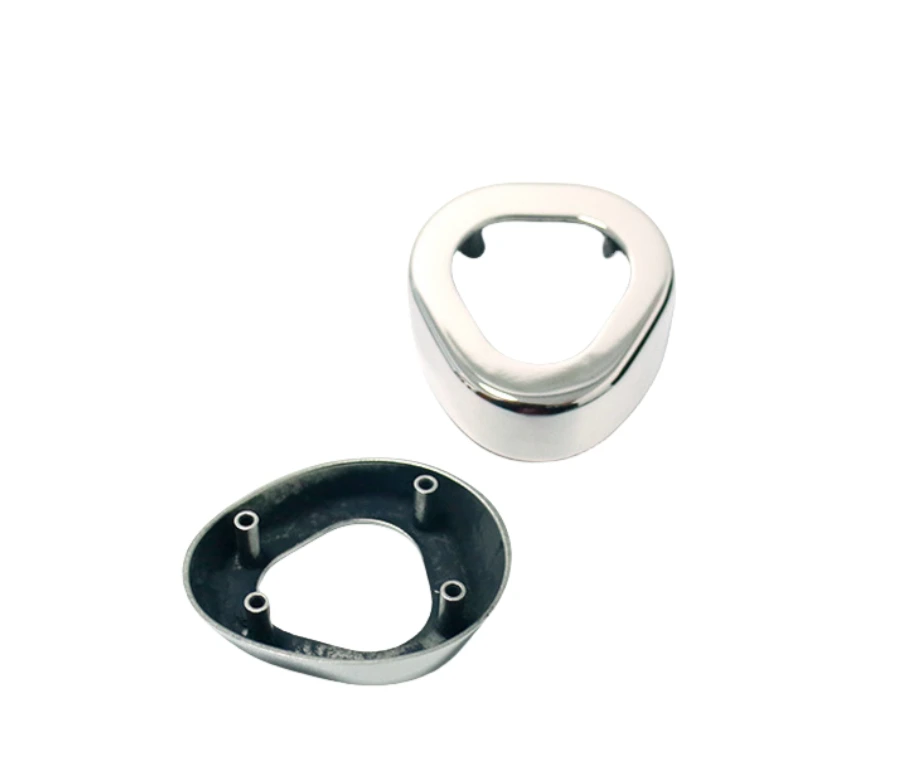
What ring and cover components enclose in a personal-care device
The catalog reference illustrates shell-like parts rather than a complete powered device.
Internal envelope, housing connection and user-contact interfaces
Specify the internal envelope, connection to the housing and surfaces exposed to the user.
Openings, attachment points and mating steps should be dimensioned from assembly datums.
Why distinguish exterior trim from a structural housing?
A trim ring may be judged mainly on appearance and attachment, while a structural housing also locates or supports internal parts.
The same external outline does not imply the same inspection requirements.
Defining the role prevents cosmetic approval from replacing a necessary fit check.
Molding or casting versus machining for wall geometry
Compare molding or casting with machining for the wall geometry and quantity.
Visible faces and locating seats may require different finishing sequences, especially where appearance and fit overlap.
Compare manufacturing capabilities →Personal-care housings: moulding, casting or sintering
For this class of part the process question is usually already answered by two requirements that are often written late: whether the surface touches skin, and whether the housing has to conduct heat away from the motor.
| Alternative process | When it wins on this part | What puts sintering back in front |
|---|---|---|
| Plastic injection moulding | Wins on the shell, the trim ring and the non-structural cover. Colour is in the material, no finishing is needed and the mass is lowest. | A thermal path, a shielding requirement or a metal-look requirement removes plastic immediately. So does any joint that has to hold a thread through repeated opening. |
| Zinc die casting plus plating | Wins on the metal housing at mid volume, where the wall fills reliably and the plated finish is the accepted look. | Plating over cast zinc is a two-layer promise: the substrate must be sound and the plate must adhere. On a thin, long housing the fill is marginal, and a marginal fill shows up as bubbles months later. |
| Aluminium extrusion plus machining | Wins on the long handle body where the cross-section is constant and the ends carry the interfaces. | Extrusion holds one section along the whole length. A pocket for the motor, a battery well, or a change of section means machining the length, which is where the cost advantage goes. |
| CNC machining | Wins at low volume and on any variant that needs a brushed or mirror face, because the finish comes from the same setup as the geometry. | The cycle time does not fall with quantity. It remains a prototyping tool and a low-volume answer, and quoting it against a volume process is not a like-for-like comparison. |
| Sintering | Wins on the small multi-feature part: a contact face, a locating ring and a mounting feature in one body, in an alloy chosen for the contact surface rather than for formability. | It loses on the large shell. A housing that has to enclose a motor is a casting or a moulding job, and sintering has no advantage at that section. |
We can compare these routes once we know the alloy, tolerances and order quantity.
On parts that touch skin, the questions to settle first are alloy and surface, not process. Nickel release, sensitisation and pitting in a sweat environment are decided by the substrate and the finishing sequence. No forming route can compensate for the wrong alloy.
Housing alloy, user-contact and delivered-condition requirements
Specify the actual alloy or functional material requirements rather than relying on color or a trade name.
Specialty material requests need an individual process review.
Define visible surfaces, contact requirements and final dimensions in the delivered condition.
Review material-selection information →Seating, housing gap and finish-consistency checks
Check seating, gap to the surrounding housing, edges and finish consistency.
Define contact, cleaning and assembly requirements for the actual device.
Quality documentation →What to include in your enquiry
- Drawing and mating dimensions.Specify the internal envelope, connection to the housing and surfaces exposed to the user. Include the drawing revision.
- Mating information. Include the assembly references needed to define the interfaces discussed above.
- Delivered condition. State material, finishing and inspection requirements, identifying any items that need a manufacturing recommendation.
- Supply plan. Include sample needs, expected order and annual quantities, packaging requirements and target timing.
- First-sample inspection.Check seating, gap to the surrounding housing, edges and finish consistency. Specify the mating part or inspection fixture.
Common questions
Does the reference include the motor or electronics?
No. The page concerns metal hardware; identify the individual components required when requesting a quotation.
Why distinguish exterior trim from a structural housing?
A trim ring may be judged mainly on appearance and attachment, while a structural housing also locates or supports internal parts. The same external outline does not imply the same inspection requirements. Defining the role prevents cosmetic approval from replacing a necessary fit check.
What should the project acceptance plan include?
Check seating, gap to the surrounding housing, edges and finish consistency. Define contact, cleaning and assembly requirements for the actual device.