
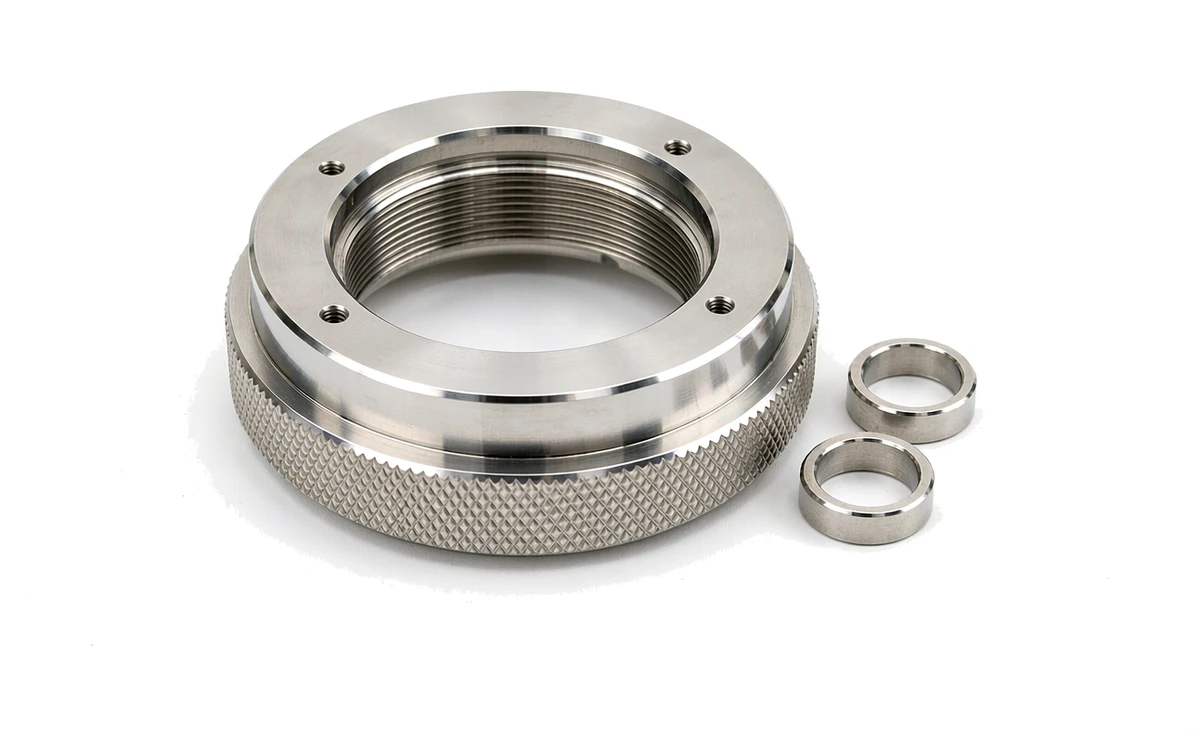
What ring-shaped fittings do in a beauty device
The reference has a visible finish, but neither its color nor appearance establishes the underlying alloy.
Ring locating diameter, attachment and exposed-face interfaces
Define the ring's locating diameter, attachment and exposed faces.
State whether it is decorative, mechanically loaded or part of a specified contact interface.
Why separate base material from decorative color?
A surface appearance is an acceptance characteristic of the finish, not a complete description of the underlying component.
Specifying the material, coating and fit separately makes it possible to compare quotations and inspect the delivered part against clear requirements.
Machining versus forming for ring sections
Compare machining and forming for the ring section and integrated features.
Review the finish sequence against final fit and the intended device environment.
Compare manufacturing capabilities →Ring fittings: decorative routes against a sintered ring
A ring is the easiest shape to make by turning, which is why sintering has to justify itself on something other than the ring itself. That something is almost always the features that interrupt the ring: a locating boss, a catch, or a face that is not a surface of revolution.
| Alternative process | When it wins on this part | What puts sintering back in front |
|---|---|---|
| CNC turning | Wins on the plain ring. Concentricity and surface finish come from one setup, and there is no tooling to commit before the design is fixed. | Turning produces one rotational contour. A boss on the face, a catch on the inner diameter, or a flat that indexes the ring all need a second operation, and the relationship between them then depends on how the part was held. |
| Tube cut to length plus machining | Wins on the constant-section ring. Cutting tube and facing the ends is the cheapest way to a ring and the wall thickness is already uniform. | A tube has one wall thickness and no features. Anything pressed, formed or cut into the wall is an operation, and a sequence of operations on a thin wall accumulates distortion. |
| Deep drawing | Wins on the thin cup or the flanged ring where a long skirt is needed and the wall has to stay thin and even. | Drawing gives a uniform wall from the strip. Where the ring has to be thick at the catch and thin at the skirt, the thickness cannot be varied, so the part ends up heavier than the design intended. |
| Zinc die casting | Wins on the larger decorative housing ring that will be plated, where the section is heavy enough to fill and the mass is acceptable. | Plating over cast zinc puts the visible surface on top of a porous substrate. On a small ring where the edges are the visible faces, that combination is where blister complaints come from. |
| Sintering | Wins where a locating boss, a catch and a decorative face are one ring, so the visible surface and the functional features never have to be brought into alignment by assembly. | It loses on the plain ring by a wide margin. Turning is quicker to quote, quicker to make, and needs no sizing or tumbling afterwards. |
We can compare these routes once we know the alloy, tolerances and order quantity.
The colour of a beauty-device fitting is routinely mistaken for a material property. PVD, plating and anodising change the surface, not the substrate. The substrate decides whether the face can be polished to a mirror and whether it will pit in sweat. Ask which one is being specified.
Ring base material, decorative color and finish requirements
Specify the actual alloy or functional material requirements rather than relying on color or a trade name.
Specialty material requests need an individual process review.
Define visible surfaces, contact requirements and final dimensions in the delivered condition.
Review material-selection information →Roundness, seating and attachment checks
Check roundness where functional, seating, attachment and appearance.
Include any customer-defined cleaning, contact or electrical requirements.
Quality documentation →What to include in your enquiry
- Drawing and mating dimensions.Define the ring's locating diameter, attachment and exposed faces. Include the drawing revision.
- Mating information. Include the assembly references needed to define the interfaces discussed above.
- Delivered condition. State material, finishing and inspection requirements, identifying any items that need a manufacturing recommendation.
- Supply plan. Include sample needs, expected order and annual quantities, packaging requirements and target timing.
- First-sample inspection.Check roundness where functional, seating, attachment and appearance. Specify the mating part or inspection fixture.
Common questions
Does a gold-colored finish identify the base metal?
No. Specify the base material and finish separately, with the required appearance and functional acceptance criteria.
Why separate base material from decorative color?
A surface appearance is an acceptance characteristic of the finish, not a complete description of the underlying component. Specifying the material, coating and fit separately makes it possible to compare quotations and inspect the delivered part against clear requirements.
What should the project acceptance plan include?
Check roundness where functional, seating, attachment and appearance. Include any customer-defined cleaning, contact or electrical requirements.