
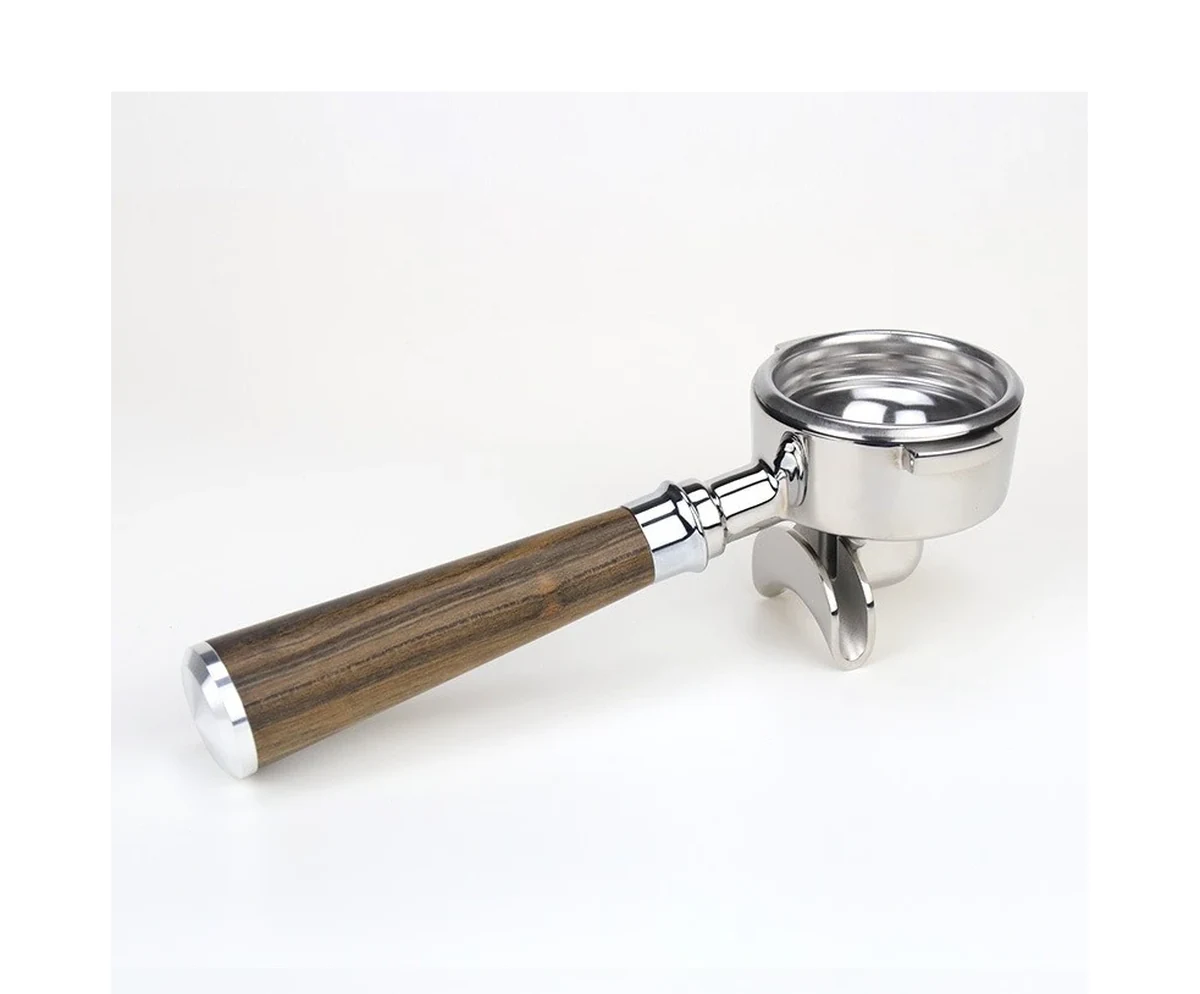
What a portafilter handle connects in the brewing assembly
Review this component together with its mating parts and delivered condition. The interfaces below define the drawing information needed to assess forming, finishing and inspection.
This reference shows assembly context for reviewing the individual metal connection and head components.
Metal part, handle attachment and machine-interface scope
Identify the required metal part, handle attachment and mating machine interface.
The photograph includes non-metal elements, which should not be assumed to be part of the quotation.
Why separate the portafilter head from handle hardware?
The head interfaces with the brewing assembly, while the handle connection establishes orientation and retention.
Those roles can require different manufacturing and inspection methods.
An assembled photograph is useful context, but individual drawings are needed to turn it into a clear supply scope.
Reviewing portafilter head, connector and fittings separately
Review the head, connector and other fittings separately because their geometry may favor different routes.
Threads, seating faces and joining operations need explicit definitions.
The proposed route is confirmed for your drawing, material and quantity. An image does not establish a fixed tolerance or a complete process specification.
Compare manufacturing capabilities →Portafilter grade, cleaning and beverage-contact requirements
Specify the required grade or performance criteria together with cleaning, wear and appearance requirements.
For any surface that contacts food or beverage, identify the applicable customer documentation and acceptance criteria.
A stainless label is not a complete contact specification.
Review material-selection information →Handle connection, orientation and seating checks
Check the handle connection, orientation, seating and agreed surface appearance.
Provide temperature, cleaning and applicable contact requirements for the actual assembly.
Specify the drawing revision and the condition in which each dimension is inspected. Record the agreed dimensional and functional checks before sample approval.
Quality documentation →Portafilter handles: thread, bore alignment and the basket interface
A portafilter handle joins three things that each demand a different reference: the group head thread, the basket seat and the spout outlets. The part looks like a handle, but the review is really about how those three references stay aligned to one another through tamping load.
| Feature | What it governs | How it is specified and verified |
|---|---|---|
| Thread form, pitch and engagement length | Whether the handle stays tight under repeated tamping torque without galling. | Thread fully specified by form, pitch and class on the drawing; checked with a thread gauge, not a nut that happens to fit. |
| Thread axis to basket seat squareness | Whether the basket sits level and the extraction runs even. | Squareness of the thread axis to the seat face; CMM, on the finished plated part. |
| Basket seat diameter, depth and flatness | Basket fit, retention and the seal at the group head. | Seat diameter, depth and flatness with a go/no-go gauge; checked against the actual basket, not a nominal size. |
| Spout bore position and internal passage | Flow symmetry between the two outlets, and whether the split is clean. | Bore positions and passage geometry; flow check on a sample, since bore position alone does not show a partial blockage. |
| Finish by zone | Hand feel on the grip, cleanability at the seat, and whether plating closes the thread fit. | Finish callouts separated for grip, seat and thread; thread checked after plating so the class still holds. |
Note. All dimensions and acceptance criteria are taken from the project drawing. The table lists the points that get reviewed; it does not fix values.
A handle body is often a simple turned or cast shape, and in that case moulding the whole part buys little. The MIM case is strongest where the body carries an internal passage, an integrated seat and a thread boss in one piece, replacing an assembly. Where the thread has to be cut anyway, it is worth pricing a moulded blank with a cut thread against a fully machined body before choosing.
Prepare a Product-Specific RFQ
- Component definition. Send the 2D drawing and 3D model, where available, with the drawing revision and the requested part or assembly scope.
- Mating information. Include the assembly references needed to define the interfaces discussed above.
- Delivered condition. State material, finishing and inspection requirements, identifying any items that need a manufacturing recommendation.
- Supply plan. Include sample needs, expected order and annual quantities, packaging requirements and target timing.
Product Questions
Is this a quotation for the complete portafilter assembly?
Not automatically. Specify whether the request covers the metal head, connector, handle hardware or an agreed assembly.
Why separate the portafilter head from handle hardware?
The head interfaces with the brewing assembly, while the handle connection establishes orientation and retention. Those roles can require different manufacturing and inspection methods. An assembled photograph is useful context, but individual drawings are needed to turn it into a clear supply scope.
How should fit and operating behavior be approved?
Check the handle connection, orientation, seating and agreed surface appearance. Provide temperature, cleaning and applicable contact requirements for the actual assembly.
Technical Context
The product-specific notes above identify drawing-review questions. General process and material references are collected separately; they do not verify a material grade, production qualification or performance claim for the pictured part.
Manufacturing and material references →